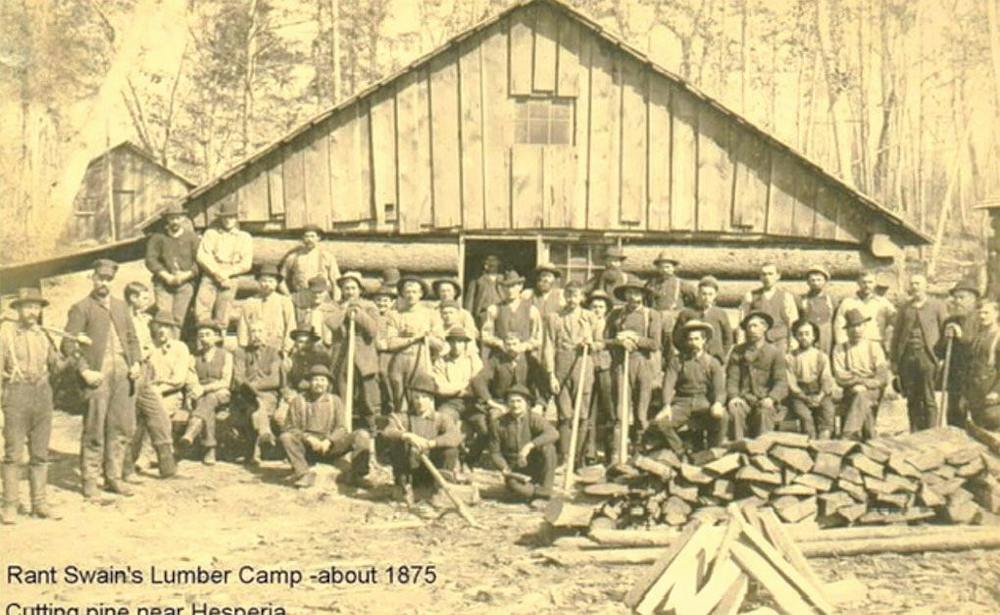
Tucked away in a quiet part of the Manistee National Forest in Newfield Township in Oceana County is a 15-acre body of water which many maps misspell as Blogget Lake. This lake is surrounded by private land but does have a public access point on the north side that is maintained by the Township.
Most lakes, but not all, were typically named after a nearby landowner that tended to be the first settler in the area. This particular lake was no different than other lakes such as Mclaren Lake, Darlington Lake, or Winter’s Lake when realizing a name.
When land in this area became available for private ownership, the vast majority was purchased by lumber interests. A plat map from 1876 of Newfield Township in Oceana County shows the lumber firm of Heald, Avery, & Gordon as owners of a nameless lake. Lakes were typically not named by the lumber interests since they owned large amounts of acreage, and naming a lake held no purpose. Their interest was to acquire the property, harvest the marketable timber, and move on to the next parcel.
The 1895 plat map of Newfield Township shows “V. Blodget” as the owner of 40 acres along the north side of the lake. The remaining land surrounding the lake was owned by “E. E. Crepin,” who was a lumber businessman and a vacant landowner. Technically, Blodget had only a small section of water frontage in the very southeast corner of his property, but since he was the early settler in this area, his name was associated with the lake.
Prior to this lake becoming known as Blodget’s Lake, it was known by a more sinister name: Dead Man’s Lake. Many local residents knew this lake by that name. For many years conversations that used the lake as a reference point would mention Dead Man’s Lake so participants would be aware of the geographic location of the discussion. If an individual mentioned Blodget’s Lake, they might have been met with the question of “Where is that?”
Inquisitive minds would ask how it got the name of Dead Man’s Lake. I wondered myself on a number of occasions that very same question. The name itself provides an easy assumption of how it was named but details always seemed to be absent when discussed with others. Nobody seemed to know the source of the name. Some would parrot what they had heard, or take the opportunity to develop their own story, but nearly all explanations centered on someone drowning in the lake.
The true story of how the lake was named remains a mystery no longer but does require some background information, so I want to take you back in time to the 1870s. The chop of the axe and the draw of the saw were heard throughout the forest. Warnings of “Timber!” and the crash of virgin pine trees to the forest floor were commonplace as lumber interests were harvesting the resources located on their holdings.
The lumber businessmen did not do the harvesting themselves, but instead contracted with certain individuals to harvest logs for their mills. The vast majority of the processing mills were located on White Lake near the outlet of the White River, and the contractors were responsible for preparing the logs for spring transport via the river system. Contractors could have jobs that required anywhere from 1 million to 15 million board feet of logs. These logs typically were cut in the winter, but larger jobs would require workers in the woods during the summer months as well.
One local contractor was Ransom Swain. Ransom developed a logging camp on the south bank of the North Branch of the White River, approximately two-thirds of a mile from the lake. From this camp the men would head out into the forest before dawn so that when first light came upon the landscape they could start the harvest. They would continue until dusk, when they would then head back to camp for a meal. There would be a couple of hours after the meal where they would entertain themselves until lights went out, usually at 9 p.m.
This process would be repeated each day, Monday through Saturday, with Sundays off. Sundays were spent writing letters, telling stories, singing songs, or whatever the men could find to occupy their time, and this is where the story begins.
Victor O’Connell was born in the year 1860, the fourth child of Bernard and Rosana O’Connell. The son of Irish immigrants, he grew up on a farm located in section 7 and 8 in Montague Township, Muskegon County, Michigan. In the summer of 1878 Victor secured employment with Ranson Swain and was present at his logging camp.
The Wednesday, Aug. 14, 1878, edition of The Fremont Times reported the following:
"A young man by the name of Montague, from Whitehall, was drowned last Sunday morning in a small lake near Swain’s lumber camp. It appears that there was but one boat upon the lake, which was a very small one-man canoe, and Montague had been in the habit of riding in it, much against the wishes of many of his comrades, on account of his being unable to swim. He had been warned often to stay out of it, there being no way possible for anyone to help him if he should upset, but being confident of his ability to navigate with it, he continued his sport, each time risking his life, until the result above stated. His body was recovered."
The newspaper obviously had gotten mixed up with his name but presented the details accordingly. From the description one could assume that Victor had engaged the one-man canoe on more than one occasion and perhaps was using it on a weekly basis to provide some entertainment on his Sundays off. His comrades were aware of his activity, and appeared to be concerned about his safety, often warning him about the potential peril to which he was exposing himself.
The Aug. 21, 1878 issue of The Fremont Times printed the following:
"We were misinformed in regard to the man that was drowned near Swain's camp a week ago last Sunday. His name was O’Connell, and his home was near Montague."
The Fremont Indicator, a rival newspaper, printed the following in their Aug. 14, 1878 edition:
"While bathing in a little lake near Swain’s camp Sunday afternoon, Victor O’Connell, living north of Montague was seized with cramps and drowned before assistance could be obtained."
It is probable that the camp members started referring to the lake as Dead Man’s Lake after Victor’s unfortunate drowning. This lake was probably noted as such until Blodget settled his 40-acre parcel and the locals started referring to it as Blodget’s Lake. The old name coined by the loggers has held on for well over a century but will eventually fade into history.
The photo included in the article shows the Ransom Swain logging camp. The actual photo date is unknown but it could have been taken in 1878, possibly in May based upon the leaf growth on the trees in the background and the sheer amount of light that is present at this camp in the forest. The workers in this photo all appear to be aged 20-40 except for the individual that is third from the left. Could this be Victor O’Connell a mere three months prior to his demise?
Two different stories from two different newspapers caused confusion regarding what truly happened to Victor. Did the members of the camp decide to concoct a story regarding the one-man canoe? Logging men were known to tell whoppers of a story and they may have decided that getting cramps while bathing (swimming) was too bland of an explanation. Regardless of what story is believed, the end result is the same. Victor O’Connell is buried in the family plot located in Oak Grove Cemetery in Montague, Michigan.