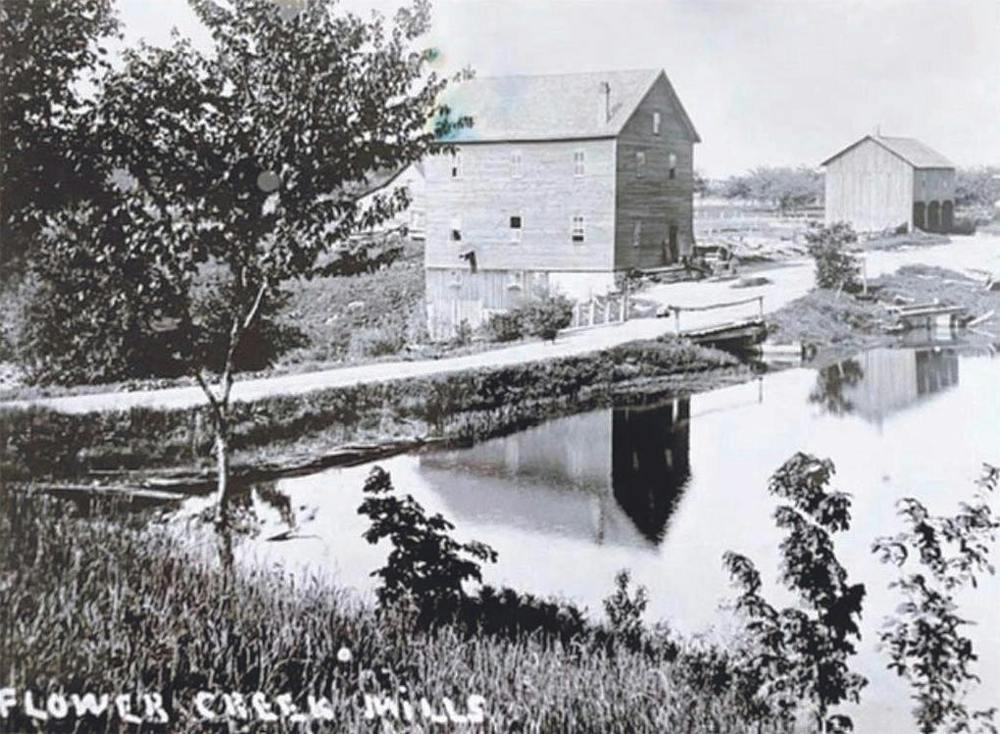
The southwest corner of Oceana County, Michigan contains Claybanks Township. This area of the county served as one of the sites for the earliest settlement of the county and was so named due to the clay banks that existed adjacent to Lake Michigan. This area was considered unique since the vast majority of Lake Michigan shoreline consisted of sand, and it also indicated to settlers that the soil was conducive to farming purposes.
Settlement of Claybanks Township started in 1849, and the population slowly grew as the untamed wilderness was converted into productive farm ground. Taming the wilderness was a task that required conviction, dedication, and hard work. Early settlers typically used the resources that existed in their immediate environment, such as the prodigious amount of trees, to construct log cabins. Frame houses initially were rare because the lumber required had to be shipped in from other areas.
The need for a sawmill and a gristmill was strong. The predominant power source for mills during this early settling period was water, and the Flower Creek was a potential source for such power. Finding a site on Flower Creek that was appropriate for construction of a dam was the first challenge, and a site that provided the desired characteristics was found on a 40-acre parcel described as the northwest quarter of the southwest quarter of section 35 of Claybanks Township, approximately a half-mile north of the south county line.
The cast of characters that became involved with this property was diverse. The story that evolved from the interaction of these characters was confusing, contrived and in some instances premeditated, and would eventually lead to the Supreme Court of Michigan.
Perhaps the first person to recognize the potential of the Flower Creek was land speculator Van Wyck Underwood, who lived in Woodstock Township, Lenawee County, Michigan. Van Wyck Underwood had acquired multiple properties from the U.S. government as part of his speculative/investment real estate strategy, one of which included the 40 acres of interest. Van Wyck Underwood sold 440 acres to Prior Foster Nov. 8, 1859, for $4,400, which included the 40 acres of interest.
An indenture dated Dec. 1, 1863, between Prior Foster and Roseann O’Connell transferred ownership of the 40-acre property to O’Connell for $450. The indenture specifically mentioned the transfer of “Flowing rights for mill purposes,” which leads one to believe that a sawmill or dam existed on the property when it was transferred to O’Connell, or that a sawmill or dam was planned for construction.
Land prices in the early 1860s averaged between $2-$8 per acre, with higher development potential properties falling on the high end of that scale. O’Connell paid $11.25 per acre for the 40-acre parcel, which could indicate that the sawmill may have been constructed prior to her acquisition and would justify the amount paid. However, Prior Foster paid an average of $10 per acre when he acquired the property in 1859, and the amount paid by O’Connell may just reflect increasing land values in the four-year period since Foster’s acquisition.
Roseann O’Connell and husband Bernard held ownership of the property for less than a year, selling to Jeremiah Collins Nov.. 18, 1864, for $450, the same price they originally paid for the property. The indenture to Jeremiah Collins also included “flowing rights for mill purposes.”
Jeremiah Collins was a Claybanks Township farmer/millwright who married Lucy Huston. Lucy was the daughter of Adam Huston, one of the pioneer settlers of Claybanks Township who had settled in 1852. Jeremiah and Lucy owned the property for several years and, in 1871, exercised a unique transaction that included the 40 acres of interest.
On Oct. 16, 1871, Jeremiah sold 120 acres in Claybanks Township, and Lot 5 of block 22 in Pentwater, Michigan to John Fay for $2,000. Five days later, on Oct. 21, 1871, John Fay sold the same property, minus Lot 5 of block 22, back to Jeremiah Collins for $1,000. This transaction seemed odd at first glance, but 18 days later, on Nov. 8, 1871, Jeremiah deeded the same 120-acre property in Claybanks Township to his father-in-law, Adam Huston, for $1 to be held as trustee for the benefit of the daughters of Jeremiah Collins, Margaret and Ellen. This deed transfer was a result of the divorce proceedings between Jeremiah and Lucy.
Adam Huston held the property in trust for his granddaughters until Nov. 29, 1875, whereupon 60 of the 120 acres was transferred to Porter Plaisted and Amos Armitage for $1,900. Paying nearly $32 per acre for 60 acres of farm ground would have been considered extreme in 1875 but was appropriate for property containing a dam and sawmill. One could speculate that Jeremiah Collins was responsible for construction of the dam and sawmill after he acquired the property in 1864.
Porter Plaisted was a farmer from St. Clair County, Michigan. Amos Armitage, originally from Canada, married Florence Plaisted, daughter of Porter, on May 25, 1875. Amos Armitage came from a family line that was experienced in sawmill and grist mill construction and operation. He may have been instrumental in convincing Porter Plaisted to move his family from the east side of Michigan to the west side of Michigan, whereupon he and his father-in-law engaged in farming and sawmill operations. The 1880 Michigan census identified the occupation of 60-year-old Porter Plaisted as “runs sawmill.”
When the dam impoundment was at maximum capacity it created a fall of 12 feet 10 inches but exceeded the West boundary of the property jointly owned by Porter Plaisted and Amos Armitage. Subsequently, on April 8, 1878, they paid $50 to the adjacent landowner to the west, John Ballard, for the small portion of his property that was inundated by the impoundment.
On Feb. 16, 1884, Porter Plaisted passed away, leaving sole ownership of the property to Amos and Florence Armitage. They promptly sold the 60-acre parcel to Amos’ brother-in-law and sister, Charles and Mary Haehnel, on March 17, 1884 for $3,000. This property transaction contained a small error in the legal description that would later become a huge problem. The parcel was described as the NE1/4 of the SW1/4, and the half of the SE1/4 of NW1/4 of Section 35, T13N, R18W, failing to indicate which “half” was being transferred. This error, seemingly blatant, would be perpetuated in subsequent property transfers.
One day after acquiring the property, Charles and Mary Haehnel exercised a $3.000 mortgage with Amos and Florence Armitage as the mortgagees. The Haehnels paid $3,000 and then received the same amount back to them the next day in the form of a mortgage, and it is believed that Charles used this money to construct the grist mill which became operational by September 1885.
Amos and Florence Armitage transferred the $3,000 mortgage held on the 60-acre property owned by Charles and Mary Haehnel to William Banks Dec. 15, 1884. This transfer was made known to the Haehnels but still contained the legal description error.
William Banks was well known in the Claybanks area as “Miller Millright” and was an early settler in the area, emigrating from England with his parents and nine siblings to Canada.
William and his wife, Jane Ann, immigrated to Oceana County, Michigan in the early 1860s while the rest of his family immigrated to Kane County, Illinois.
On April 19, 1886, William Banks transferred the $3,000 mortgage to his youngest sibling, Henry Clay Banks, for past and future care of their aged mother who had become widowed in 1877. This transfer still containing the legal description error, was not made known to the Haehnels.
Jane Ann Banks passed away sometime around 1886 or 1887. In 1888, William Banks was visiting family in Illinois when he met their domestic servant, Rosina Smith. Rosina had just immigrated to Illinois from England and William took a fancy to her. He proposed marriage to Rosina, and she accepted. The 52-year-old William took his 24-year-old bride back to Michigan.
As far as Charles Haehnel was concerned, he owned the grist mill, sawmill, dam, farmhouse, and 60-acre farmstead. He operated the mills and was thriving as best he could, investing time, effort, and resources into improvements of the grist mill. In 1889 he built a lime kiln and burned limestone to create nearly 60 barrels of quicklime, a key ingredient of mortar, and employed a crew to build a stone basement under the gristmill. This action showed that the gristmill was originally built without a stone foundation.
By October 1890, Charles Haehnel had the grist mill functioning at peak performance. Many people came from all directions to utilize the mill due to the favorable reputation it had developed as well as the quality product it produced. People traveled from surrounding areas such as Montague, New Era, Whitehall, Shelby, Ravenna, and Grand Haven to have their grain ground into flour. Boys relished the task of taking grain to the mill for their fathers, as it allowed them an opportunity to fish the mill pond while they waited upon completion of the milling job. During the winter when the ice was thick on the mill pond, many people would cut the ice into blocks and store it for summer, using the copious amounts of sawdust from the sawmill for insulation.
The mill business was operating quite successfully but in 1893 Charles Haehnel had challenging financial issues to deal with, particularly two other mortgages, one in the amount of $1,000 held by the Cook estate, the other in the amount of $1,500 held in the name of Porter Plaisted, of which $250 remained. He still had the $3,000 mortgage that he erroneously believed William Banks held, so he developed a proposal to alleviate some of the mortgage burden. He proposed to William Banks that he would pay off the mortgage held by the Porter Plaisted estate; he would deed ½ interest of his property to William Banks; that William Banks would discharge the $3,000 mortgage with $500 interest; that he and William Banks would enter into a co-partnership to improve the grist mill; and that he and William Banks would share equally in expenses and profits.
The proposal was verbally agreed to by William Banks in June 1893 with full knowledge that he did not have any legal interest in the property. Charles Haehnel procured a discharge of the mortgage held by the Porter Plaisted estate, and efforts were undertaken to improve the grist mill by employing a man to tear out the machinery in the mill. Additionally, Banks and Haehnel traveled to Chicago to order roller process machinery for installation in the grist mill.
Banks and Haehnel traveled to Montague, Michigan to meet with attorney William E. Osmun for the purpose of drawing articles of co-partnership. It was at this meeting that Haehnel discovered that the $3,000 mortgage he believed to be held by William Banks had been transferred to Henry Clay Banks of Elgin, Illinois. This was shocking and sobering information for Charles Haehnel, and in response William Banks immediately backed out of the verbal agreement and refused to perform any of the agreement caveats.
Charles Haehnel found himself in a situation where the grist mill was inoperative, he had parted with $250 to discharge the mortgage held by the Porter Plaisted estate, and the $3,000 mortgage was still valid. Perhaps more disconcerting to Charles Haehnel was the fact that William Banks verbally entered into an agreement with him with full knowledge that he (Banks) had no legal interest in the property, indicating an almost devious intent.
Having few options, Charles Haehnel filed a bill in chancery in the Oceana County Circuit Court with the intent that the $3,000 mortgage held by Henry Banks be declared to be the property of William Banks, and that the subject mortgage be discharged of record, and that William Banks be compelled to perform the caveats of the verbal agreement. Judge Palmer, on Oct. 14, 1895, decided in favor of William and Henry Banks, dismissing the bill of complaint, and granting Charles Haehnel leave to bring suit in a court of law.
Henry Banks initiated mortgage foreclosure proceedings against Charles Haehnel in December 1893. The property was brought to public auction by the Oceana County sheriff at noon March 3, 1894, but no bids were received. The auction was adjourned to March 10, 1894, where only one bid was received in the amount of $685 from William E. Osmun. Ownership of the property was transferred to William E. Osmun with the legal description error still intact. He held ownership of the property until June 17, 1895, whereupon he quit-claimed the property back to Henry Banks for one dollar, with the legal description error still intact.
It is unknown why William Osmun quit claimed the property deed to Henry Banks after paying $685 for it. Osmun served as legal counsel for William and Henry Banks during the bill of chancery proceedings in the Oceana County Circuit Court, brought about by Charles Haehnel, and may have realized he purchased the property with an erroneous legal description. He may have thought it prudent to rid himself of the property knowing that clear title was not evident.
The Oceana County Circuit Court issued a judgment in the bill of chancery proceedings Oct. 14, 1895, with the correct legal description of the property. Eight days later, on Oct. 22, 1895, quit claim deeds were exercised by Charles and Mary Haehnel, and Amos and Florence Armitage, as Grantors to Louis M. Hartwick as Grantee. These deeds transferred the south half of SE1/4 of the NW1/4 of Section 35T 13N, R18W, which was the 20-acre portion of the full 60-acre parcel that had been erroneously described in 1884 but was now the correct legal description. Louis Hartwick was an attorney who bizarrely exercised the quit claim deeds while having full knowledge that Henry Banks was the legal owner of the subject 20 acres.
Henry Banks obtained a writ of assistance from the Oceana County Circuit Court Nov. 10, 1895, establishing full ownership with clear title to the 60-acre property which now had the correct legal description. A writ of assistance is a legal document that orders a party to take action, such as conveying a deed or delivering a document, as directed by a court. It can also be used to evict someone from property or enforce a court order related to land ownership.
Charles Haehnel had lost everything. He moved his wife and six children to Montague and started over. Amos Armitage moved to Tyrone Township, Kent County, Michigan and was operating a grist mill at that location.
Henry Banks was probably relieved to put the property ownership issue behind him and proceed with activity at the grist mill and sawmill. He employed his sister-in-law, Rosina (wife of William) to run the mills. She, in turn, hired William Brocker to operate the grist mill. Henry’s brother William became sick in 1897 and passed away Aug. 28, 1898, leaving a widow (Rosina) and a son, William.
Louis Hartwick, former attorney for Charles Haehnel, decided to rid himself of the 20 acres that he legally did not own. Using a quit claim deed dated March 8, 1898, Hartwick transferred the 20-acre property to Mary G. Osmun, wife of William Osmun, former attorney for Henry Banks. Mary Osmun used the same method April 25, 1898, to transfer the 20-acre property to Herman Boyd, who shortly thereafter leased the 20 acres to farmer Dan Allen.
Henry Banks traveled to Claybanks township to attend the funeral of his brother William. While there, Henry decided to visit his property. Strolling about the 20 acres illegally leased by Herman Boyd to Dan Allen, he came into contact with Allen. Believing Henry to be a trespasser, Allen threatened to forcibly remove him from the property. Suddenly, property ownership had become an issue that Henry had to deal with once again.
Henry brought suit against Dan Allen, Herman Boyd, and Mary E. Osmun, (defendants) which went to the Michigan Supreme Court. On Sept. 23, 1901, the Court ruled in favor of Henry Banks stating that the conveyances from Charles Haehnel and Amos Armitage to Louis Hartwick, then to Mary E. Osmun, then to Herman Boyd, and the lease from Herman Boyd to Dan Allen were null and void. The defendants were directed to quit claim all of their claims, rights, title and interest to Henry. Additionally, Henry was authorized to recover court costs from Dan Allen and Herman Boyd. It is unknown why Louis Hartwick and Mary Osmun were not required to pay court costs to Henry. It is also unknown if Henry pursued court costs from Dan Allen and Herman Boyd.
Henry was probably relieved to finally have clear title to the property but most likely desired to be free of this issue that had become a burden and financial drain. Rosina Banks, with the assistance of William Brocker, had managed the mills during the court proceedings, and shortly after the Supreme Court ruling, ownership was transferred to her by Henry. Clear title to the property was now established and William Brocker took action. On April 19, 1902, Rosina (nee Smith) Banks and William Brocker were married, and together they operated both the grist mill and sawmill. On Aug. 10, 1903, they had a daughter, Bessie K. (1903-1992).
Improvements to the grist mill were made and business was going quite well. The reputation of the grist mill continued to be exemplary, and life was going well for William and Rosina - until June 6, 1905.
One of the most disastrous storms to visit the West Michigan area dumped torrents of rain upon the area for nearly 48 hours straight. The Covell dam, located approximately 2 1/2 miles upstream of the Flower Creek dam, failed under the relentless rain, releasing the pent-up water, logs and debris to flow downstream. William and Rosina had removed the slash boards from their dam and had done all that they could to facilitate the passage of water but when the wave from the Covell dam blowout reached them the logs and debris piled up. A tremendous force was exerted on the dam, and it blew out.
When the storm had passed, and the damage could be assessed, William and Rosina found that a section of the dam approximately 80 feet wide had been washed away, and that the sawmill had been swept away. The grist mill remained intact due to its location on higher ground but the estimated loss they endured was about $1,000.
Dismayed by their ill fortune, they nonetheless commenced rebuilding the dam in August 1905. During this time another strong storm sent water levels to flood stage, and it was with great difficulty that the water was kept from destroying what had been rebuilt up to that point. The dam was finished by fall of 1905 and the grist mill began running nearly nonstop. The sawmill was not rebuilt.
The grist mill flourished after the 1905 calamity, and in 1908 they opted to rent their farm and stock. It is unknown if they succeeded with the rental, but this was evidence that the mill activity was requiring a great deal of their time. They did custom grinding every day except for Saturday afternoon, and people took advantage of that schedule. Surprisingly, they purchased 14 ½ acres May 3, 1909 to add to the farmstead, bringing the total size to 74 ½ acres.
In September 1917, the 74 ½ acre farm, including the grist mill, farmhouse, barns, etc. were listed for sale with the comment from 58-year-old William that he was unable to do the work and would take a small farm or good residence as partial payment. The sale did not materialize and on March 3, 1920, an auction of stock and implements was held due to Williams’ inability to operate the farm.
William and Rosina were at an impasse with their property. They were unable to operate, or sell the farm and grist mill, and were probably aware that the mill operation was slowly becoming obsolete with the advent of electricity. Unsure of what to do, Mother Nature helped them decide by delivering another storm in early March 1922 that sent flood waters to assail the dam. The dam held but sustained damage to the spillway and apron, amounting to a loss of several hundred dollars. The bridge that had spanned the dam sustained damage as well, resulting in condemnation, and was subsequently closed to traffic.
Sixty-three-year-old William and 55-year-old Rosina had reached their limit. They bought a home in Maple Grove on Prospect Street in Montague, Michigan and moved to that new residence May 1, 1922, still maintaining ownership of the farm, the failed dam and the inoperative mill. The grist mill operation ceased since the dam was not repaired, and the road remained closed until September 1922 when the bridge was repaired.
News that the farmstead was no longer occupied stimulated someone to try their hand at thievery. William and Rosina motored to their farm in early October 1922 to find that their home had been entered and several pieces of furniture had been stolen, along with two suitcases. The mill had also been broken into and several tools were missing. This was the beginning of the inevitable decline of the mill.
William and Rosina eventually sold the 74 ½ acre farm, which included the grist mill, farmhouse and barns. The grist mill deteriorated over the next few decades until it was dismantled in 1957. One can see the only remaining evidence of the grist mill on the north side of Flower Creek Road, just east of Flower Creek, in the form of the foundation.
In November 1926, Rosina’s son from a previous marriage, William H. Banks, died in a tragic automobile accident in Grand Haven. He was 37 years old, married, and had a young daughter. He was buried in Oak Grove Cemetery.
By 1935, it appears William and Rosina had moved to their daughter Bessie’s home in Elgin, Illinois, where she worked as a registered nurse. That is where William died April 20, 1935, at the age of 75. His body was returned to Montague where he was buried in Oak Grove Cemetery.
Rosina remained in Elgin, Illinois, where she died March 4, 1946, at the age of 81. She is also buried in Oak Grove Cemetery.