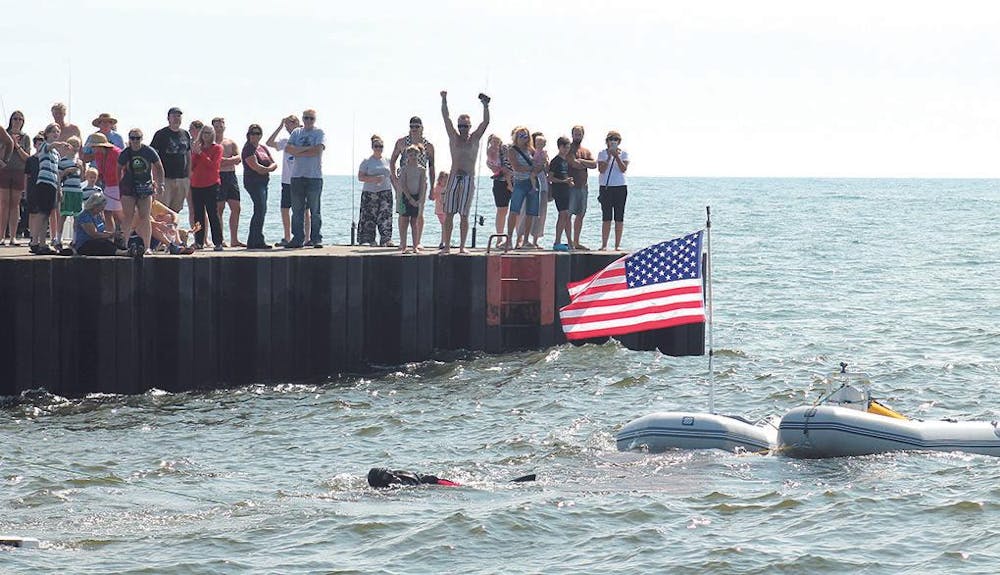
WHITEHALL — The White Lake Maritime Festival, by all accounts a rousing success throughout the weekend, reached a crescendo Saturday night when endurance swimmer Jim Dreyer arrived at the Goodrich Park marina towing 250 cannonballs, having completed a 22-mile swim that took some 30 hours.
Dreyer was towing the cannonballs in honor of the 250th anniversary of the United States, and the 22 miles was in remembrance of the number most associated with daily veteran suicides in the U.S. The cannonballs are slated to be used in the construction of a combat veterans memorial to be placed in Whitehall; the city council discussed potential locations at Tuesday's work session but has not yet made a final decision on its placement. The goal is for the memorial to be constructed next year.
Although Dreyer was a few hours later than planned - he originally hoped to arrive at 6 p.m. and ended up pulling in at about 10:15 - he was still greeted by an honor guard made up of members of the White Lake VFW and American Legion, as well as an enthusiastic crowd still enjoying themselves in the beer tent while the band The Edukators performed.
Following a brief celebration of Dreyer's arrival, part of the honor guard performed a three-rifle volley, and American Legion Post Commander Mark Helms presented a U.S. flag to Whitehall mayor Tom Ziemer. Helms said the plan is for the Legion and VFW posts to again collaborate on a flag-raising ceremony at the memorial's site once it is built.
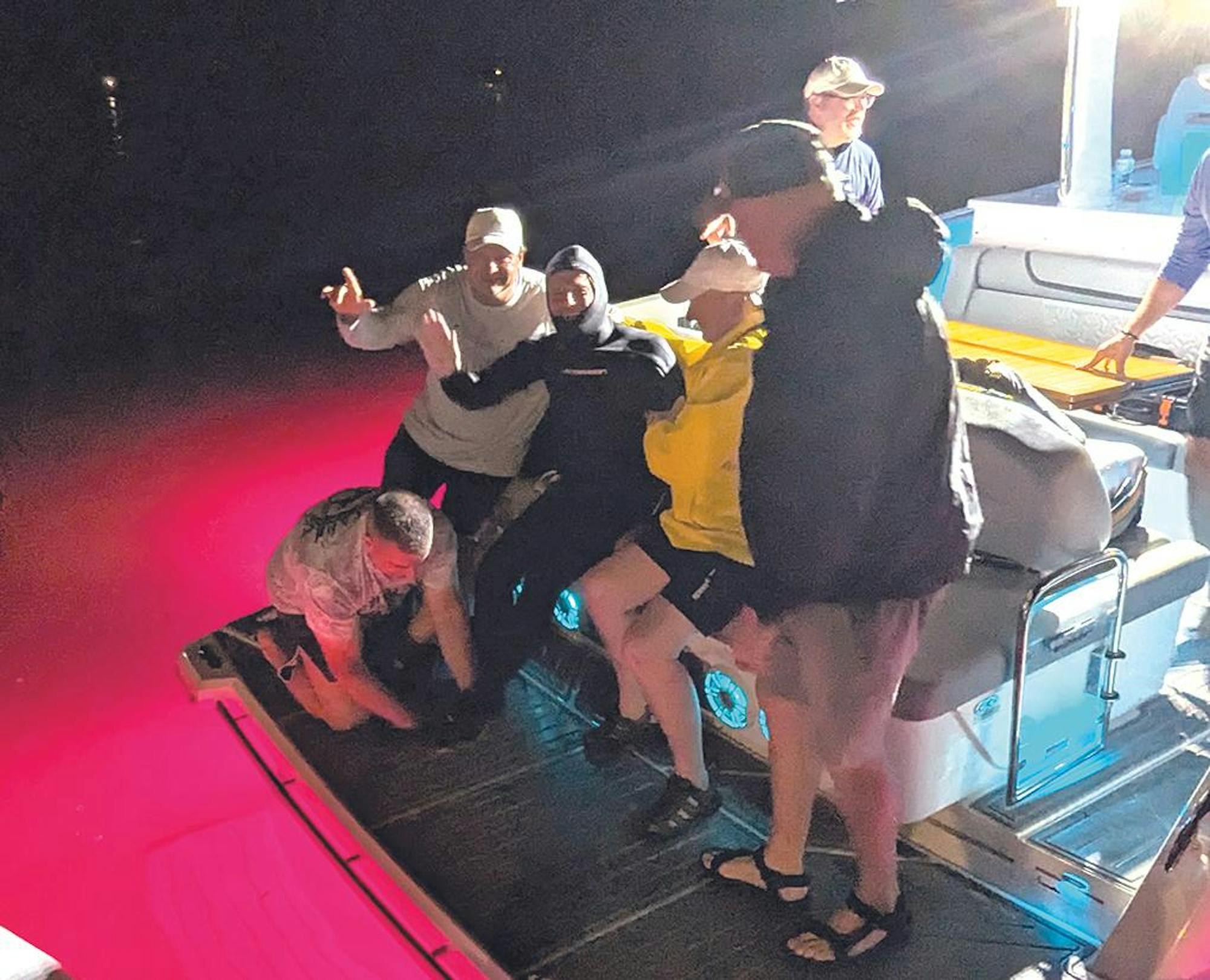

"It's something I'll never forget and my team will never forget," Dreyer said Tuesday in a phone interview. "It was such a warm and enthusiastic welcome. It feels good when the community shows you that much love. Beyond that, one thing that really resonated with me is how much everyone got the greater purpose, grasped and embraced the memorial. When I or anyone was speaking, whenever anyone mentioned the memorial, it got a cheer. The honor guard was there, and they really got what it was all about.
"There's no doubt in my mind Whitehall was the right choice for this memorial. It was clear. Whitehall was one of six possible localities, and the relationship with Whitehall, for me and my team, has continued to grow throughout this entire process."
Dreyer added that he was impressed, during the Maritime Festival, to see that many of the same people he was working with on his swim were also volunteering during the festival.
Dreyer's late arrival, he said, was the result of difficulties he had, both in the water and with the dinghies that were attached to his ankles throughout the swim, but the obstacles he faced made the swim more meaningful.
"The honor guard's presence, the mayor's presence, the whole ceremony underscored how important the memorial is to Whitehall and the White Lake area," Dreyer said. "It means the world to me. When I first envisioned this, I couldn't have scripted it better...The finish adds to the drama. If it was too easy, it'd be boring."
Dreyer's late arrival, he said, was due to being knocked off course by the current in Lake Michigan. At one point, he had swam 16 miles but was so off course, having headed too far south, that it would've taken him much longer than his 22 miles to complete the swim. After discussion with his support team, he agreed, despite it being "against every fiber in my body as an athlete," to be transported by boat to where he needed to be so he could complete the 22-mile swim.
"My team and I agreed that it was bigger than me," Dreyer said. "Delivering those cannonballs for the memorial is what this was all about. It became very clear that's what we had to do. I will get in the 22 miles, I just won't do the extra miles that Mother Nature is asking me to."
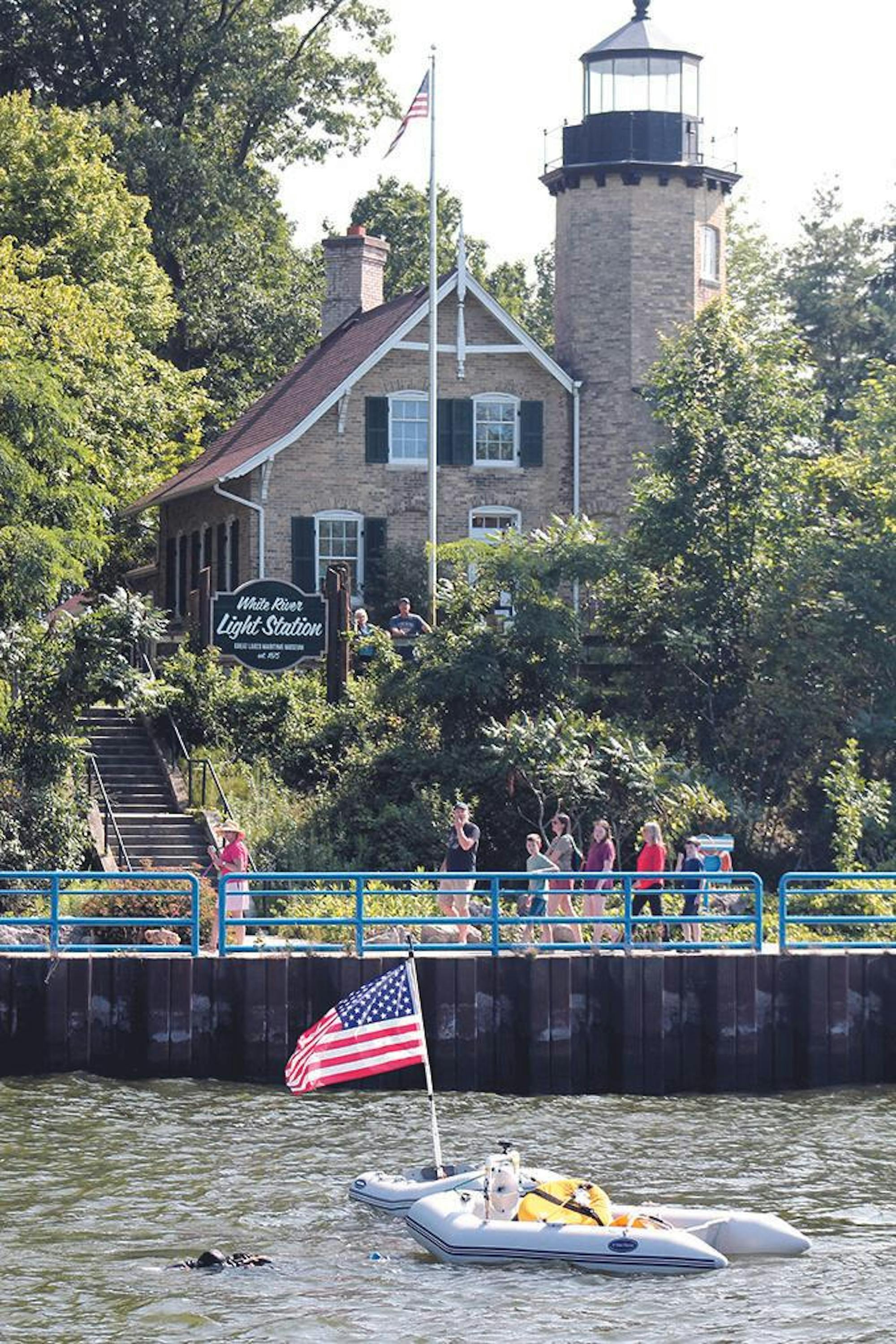
Part of the reason Dreyer agreed to the detour is because at one point one of his dinghies was in jeopardy of sinking into the water, along with the cannonballs it was towing, due to the ropes coming apart. He spent much of the early morning Saturday putting together a makeshift solution that would keep the dinghy above water, ending up towing both dinghies next to one another rather than his original plan of having them separated by another rope.
Dreyer also faced physical obstacles, beyond the waters of Lake Michigan. When he resumed swimming Saturday upon coming up with a solution to his dinghy issue, he noticed some soreness on the left side of his chest. He's since self-diagnosed a separated rib, saying he's had one before and knows the symptoms.
"It's nothing I haven't dealt with, but the adrenaline of the whole thing and the warm reception, it just helps you persevere," Dreyer said. "We were never, never going to give up anyway, but it adds fuel to the fire and keeps you going."
Once he reached the channel separating Lake Michigan from White Lake, Dreyer said he received enthusiastic support from spectators, adding even more fuel to his fire.
The honor guard was an easy sell for both the VFW and American Legion chapters, who will act as the fiduciary as funds are raised for the memorial through the sale of cannonballs. Any money brought in beyond the memorial's costs will be distributed to those organizations.
Both Helms and VFW Post 3256 Commander Ken Vanderstelt expressed pride at Dreyer's swim and the mission behind it.
"(It's remarkable) that he uses the physical abilities he has to do something for organizations like ours," Vanderstelt said. "I know he's done them for the Boys (and Girls) Club and some other organizations. His heart's definitely in the right place."
The cannonballs Dreyer towed can be reserved in honor of a veteran or veterans via his website, jimthesharkdreyer.com. The donation to reserve a cannonball is set at $750, but no money is being collected yet; Dreyer hopes to advance to that part of the process soon.
"The sooner the cannonballs are sold, the sooner it can be built," Dreyer said.