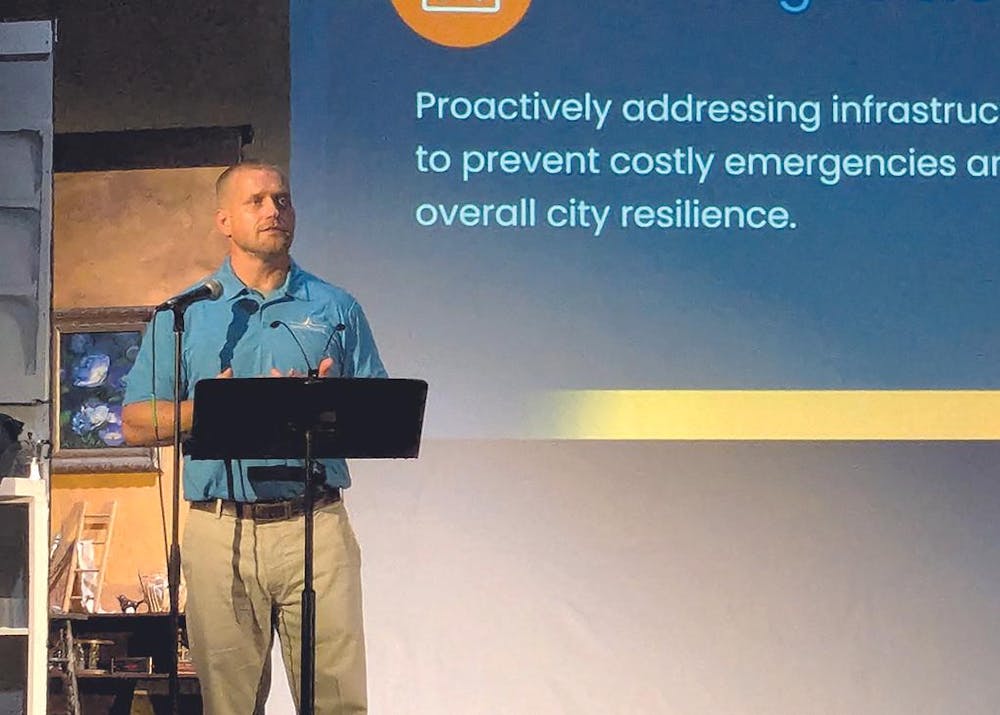
WHITEHALL — Whitehall City Manager Dan Tavernier has said multiple times that he feels local government works best when citizens are engaged. That belief likely informed his desire to host a public town hall meeting Monday at The Playhouse at White Lake, sharing some of the things that have been done in the city during the one year he's been on the job and outlining some of the things he hopes to see in the future.
Tavernier closed the evening by saying he hopes to make this town hall an annual event.
"I love this city," Tavernier said. "This city gave me a shot to be its manager, and I hope I'm approaching that level of appreciation in my work."
The town hall is an extension of Tavernier's time spent in city hall during regular hours, where he joked that he almost has to block off time to field resident feedback. However, it fits with his belief that an engaged citizenry is a good thing. He said during the presentation that since it is his job to make decisions, he'll happily take the blame if residents disagree with one, as long as they field an explanation of why it was made.
Tavernier also fielded several compliments from residents pleased with his work in the job, which he deflected by noting that being surrounded by "competent people" on the city staff who are good at what they do enables him to focus on his job and keeps the whole city running better.
The presentation touched on many topics, including the investments the city has made in roads and infrastructure, as well as parks and neighborhood improvements.
Tavernier also emphasized the business-friendly efforts the city has pursued, like the facade improvement grant program and the establishment of the Obsolete Property Rehab District, giving business owners the opportunity to gain temporary tax abatements to encourage investment. Examples of these include the work being done at Lake Land Getaway and the old Family Video/Dollar Castle building, both on Colby Street.
"Our goal is simple - to build a community that is both business-friendly and family-friendly while making smart investments that improve quality of life for everyone," Tavernier said.
An estimated $100 million, Tavernier said, of the city's $169 million tax base is currently being abated under those agreements, but as those abatements run out in future years it will increase Whitehall's tax revenue significantly. One batch of abatements is set to expire in 2030, Tavernier said, and more in 2034. The city will also soon start receiving more tax money from the development occurring at Tannery Bay.
Roads have long been a hot topic in Whitehall, and Tavernier knows it, saying that it's his view that a road project should pretty much always be in progress in the city. Several have been done this year already, and more are scheduled. Tavernier shared the differences between the three kinds of road construction projects; from least to most expensive, they are "mill and fill," where only a couple of inches of road get replaced, "crush and shape," where the top layer is ground up to make a new layer, and a total reconstruction. Muskegon Avenue and Livingston Street, slated for work in the next couple of years, fall into the latter category. Livingston in particular is set to be split into two segments; south of Bush Creek will be done next year, and north of Bush Creek will be done in 2028.
It's that project in particular that has caused some financial creativity in the city office, Tavernier said. When the council authorized him to issue $8.5 million in bonds to support road projects last fall, the city was working off of estimates from prior capital improvement plans, which proved to be underestimating the costs due to inflation. It helped that the Tax Increment Finance Authority and Local Development Finance Authority both agreed to divert money to the city to help pay the bonds back, which the city will do over 10 years.
Asked about the bonds, Tavernier said it was one lever available for the city to help finance such projects; the city is able to take out up to $19 million in bonds without voter approval, though he added going that high would stretch the city budget. He is in favor of using bonds judiciously because it enables the city to lock in work at today's prices to beat inflation, noting that in the past the city would save money until it was able to pay off the projects in full. While an admirable aim, he said, it led to projects becoming more expensive than originally planned.
During the Q&A portion of the presentation, residents asked about other topics, such as ebikes, pedestrian safety and even an LED sign outside City Hall to keep residents updated on events. (Tavernier said the latter topic was "probably the second thing" Mayor Tom Ziemer brought up to him upon taking office in November.)
Traffic safety was addressed as well, with discussion of traffic on Colby Street. One commenter suggested the addition of another traffic light on Colby between the current ones at the Aldi plaza and downtown, though the addition of a stoplight would be a Michigan Department of Transportation matter.
Also addressed was the West Colby Promenade, which residents were frustrated has not been "substantially completed," as was originally scheduled by late June. Tavernier is optimistic it will be ready by the end of summer and said he is in regular communication with Clifford Buck, the company constructing the area.
Driving citations have doubled under the new city system that records them as ordinance violations, allowing the city to receive all the revenue without charging drivers. More importantly, Tavernier and police chief Brandon Mahoney said, the city is targeting problem areas for citations so as to avoid accidents and hopefully keep drivers safe on the road.