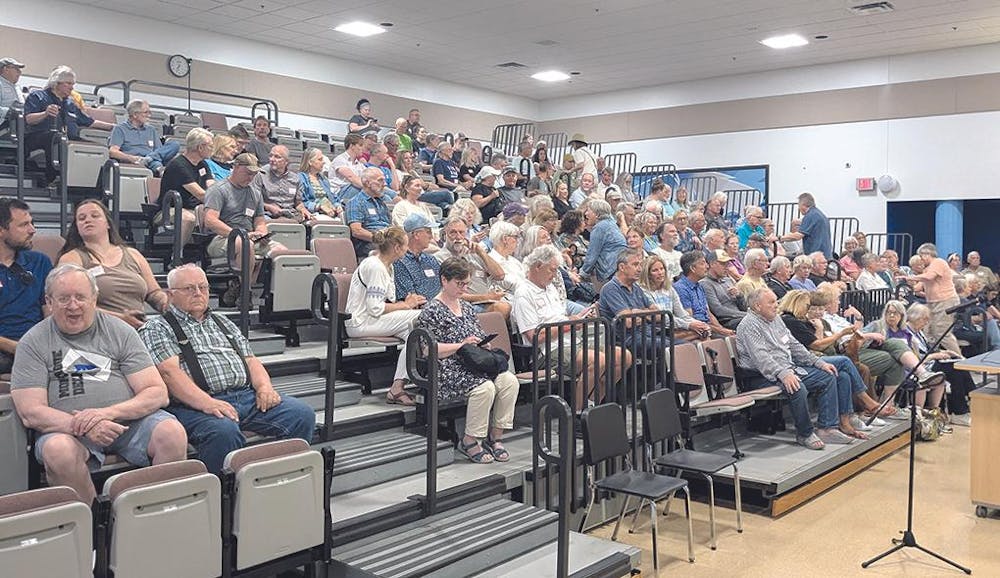
MONTAGUE — The Chemours Environmental Impact Committee lodged its objections to the cleanup plan proposed by Chemours last Thursday night in a public meeting at NBC Middle School that dozens attended.
The meeting was a step along the way to a potential approval of Chemours' cleanup plan for the environmentally troubled site it owns in the area. Chemours spun off from DuPont in 2015, and the site was a DuPont plant from the 1950s until 1996, when it closed; the facility was demolished in 1998.
According to Scott Roodvoets, whose late father David helped found CEIC, a public meeting is not usually held at this point in the process - between the Corrective Measures Study (CMS) and its approval, which progresses it to the Corrective Measures Implementation - but CEIC requested and was granted the meeting by both Chemours and the state Department of Environment, Great Lakes and Energy (EGLE).
"Two generations have lived with the contamination at the site," Roodvoets said. "Enormous time and resources have been spent and will be spent dealing with what was left behind... We know much of what's here and we know what it can do. I encourage everyone in this room not to make the mistakes of the past. We have the opportunity before us to not just do what's easiest and least expensive. The opportunity is to do what's necessary to do the right thing and helps us in the future."
Chemours is slated to deliver its official response to EGLE's comments regarding Chemours' CMS, which it delivered May 4, by June 18. Chemours' original plan was submitted last fall. If EGLE signs off on Chemours' June 18 revisions, the plan could be approved for implementation.
CEIC's Claire Schlaff shared objections the organization has to Chemours' plan, and mainly its approach to the existing 14 areas of concern the organization said are on or near the site. Eleven of the 14 areas are on the Chemours site itself; two (Pierson Creek and the Pierson Creek landfill) are located a mile west of the site; and the Pierson Creek landfill plume, which distributes groundwater elsewhere in the area.
Chemours' plan, according to its CMS, is, in part, to continue existing monitoring practices in the area and keep people away from the area to ensure they are working while preventing further contamination of the site. The plan would also include an additional well being installed at Pierson Creek Landfill, enabling further monitoring of groundwater as it enters Pierson Creek, and a geotextile cap at the landfill intended to prevent any further contamination. Restrictive covenants would be put in place in affected areas that prevent certain uses of the land, including any use of the groundwater as drinking water.
CEIC, meanwhile, wants a more thorough cleanup of the area that would include consolidating all the contaminants in the 14 areas of concern into a larger, enclosed facility, similar to what was done with the Hooker chemical plant in the 1980s. CEIC cites studies that suggest geotextile caps could be a source of PFAS - "forever chemicals," as they do not biodegrade - as reason not to support such a measure. The organization also said that in the case of five of the 14 areas of concern, Chemours found that CEIC's goal of consolidation was effective and able to be implemented, but was not selected. In one other area of concern - a recently uncovered copper catalyst release area - Chemours' plan calls for off-site disposal of contaminants rather than consolidation.
CEIC also disputes Chemours' plan to continue with the "pump and treat" method of treating contaminated groundwater. While CEIC conceded that is a necessary step, it does not feel the method can be considered a permanent solution in the way the removal and consolidation of the sources of contamination could be. According to discussion during the meeting, the "pump and treat" system treats and discharges 600-700 gallons of water per minute. Treated water may be used as drinking water if it meets water quality standards that are in place outside of the area with the treated water, or what's called the "mixing zone."
CEIC does, however, have concerns about whether that treated water makes it all the way to White Lake, citing the "already stressed" nature of the Sadony Bayou ecosystem and the high sand levels that sometimes inhibits water flow from the bayou.
The tenor of the meeting was mostly cordial throughout, although during the Q&A session that ended it, a couple of area residents expressed frustration at what they deemed Chemours' disinterest in undertaking a more thorough and expensive cleanup of the site, citing DuPont's $19.55 billion market cap as evidence it can afford to do so. Chemours project director Sathya Yalvigi, who has been involved with the site for some time, maintained that the company is attempting to satisfactorily clean up the site.
EGLE solid waste manager Rhonda Oyer did note the increased costs to implementing CEIC's desired plan, saying that she learned in discussions with a geotechnical engineer at EGLE that construction of a new hazardous waste landfill runs around $2.2 million per acre; Pierson Creek Landfill is a little more then two acres in size. A geotextile cap was found in Chemours' CMS to cost $1.43 million, plus some associated costs such as tree removal.
Sam Cairns, a senior EGLE geologist, shared during the meeting that he sympathized with those in the crowd who were dissatisfied with Chemours' proposal and noted that the department is not legally allowed to strong-arm the company into more exhaustive cleanup measures; if Chemours' proposal meets set standards, it is permitted to pursue it. Put another way, if the company proposed five possible remedies, EGLE could inform it if one of the remedies were legally impermissible but could not compel the company to pursue any specific one of the other four.
"No one ever wants to hear this, but contact your local representative," Cairns said of ways the public can pursue more thorough cleanup methods.
EGLE did add that Chemours will be responsible for addressing the water contamination in the area both on and off-site, though in the case of off-site water, the permission of current landowners would be necessary to enact monitoring methods.
Cairns also discussed volatilization to indoor air pathway (VIAP), a phenomenon under which specific chlorinated contaminants' properties lend themselves into being in the gas phase rather than the liquid phase of matter and can work its way into occupied structures. The research into the matter was due to high quantities of acetaldehyde in soil on the Chemours site. However, he emphasized that there's no evidence at this time that any vapor sources pose a danger outside the Chemours site.