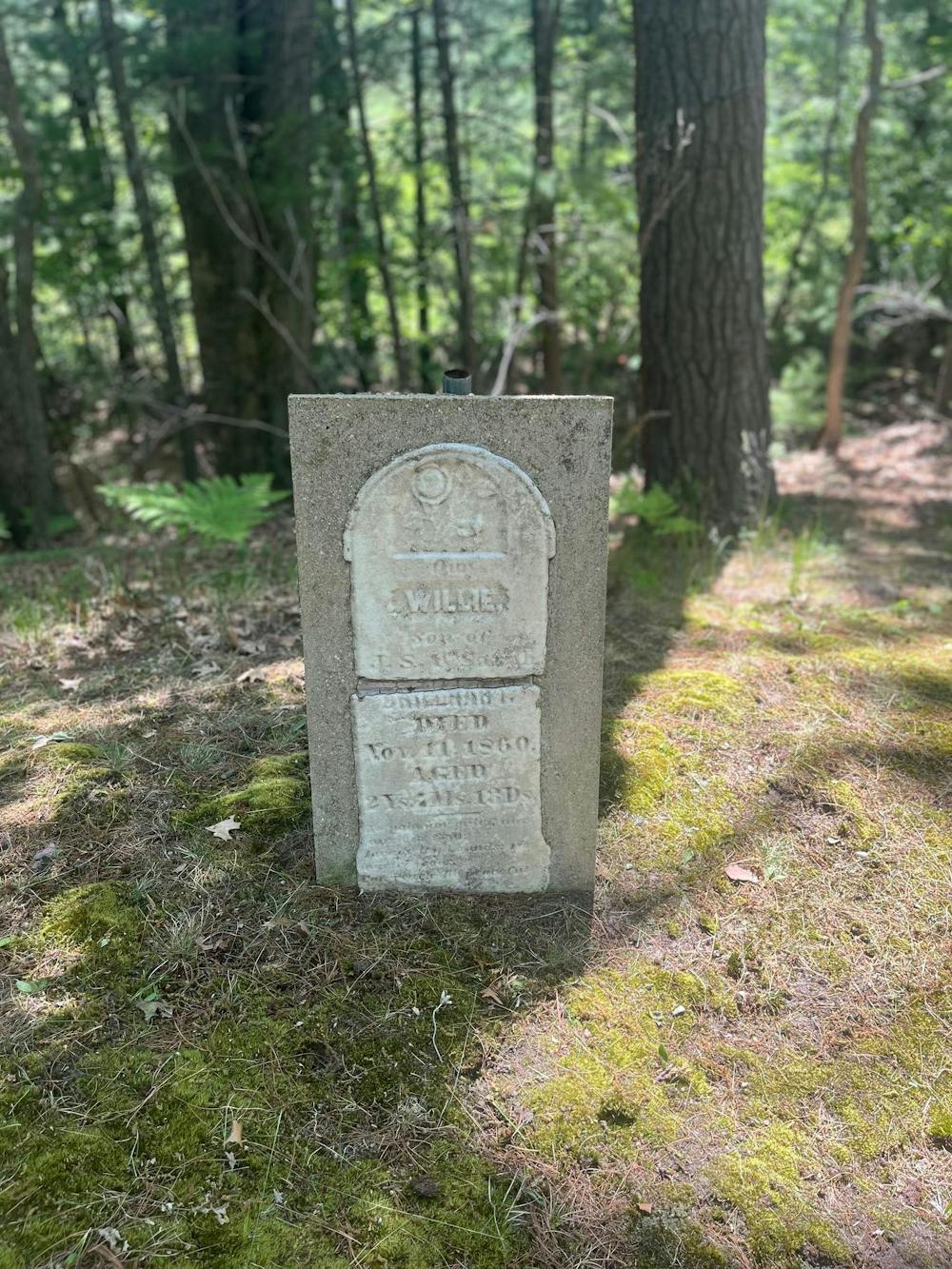
Five years ago during the Covid pandemic when socializing was discouraged, a Pentwater resident found a new pastime and way to exercise. Ron Beeber took a weekly stroll through the Pentwater Township Cemetery and leisurely studied the headstones. Noting dates and names that spanned more than two centuries, he recognized many persons mentioned in the history of Pentwater and found residents who had fought during the War of 1812 and the Civil War as well as veterans of WWI, WWII and Vietnam. When the information etched in stone piqued his interest, he took time to research the names and record his discoveries.
Adding photos of people, buildings and events to his written information, Beeber created a presentation that he shared at the Pentwater Service Club's May 28 meeting. Beeber describes the cemetery as an “open-air museum,” and his interest reflects that of “people around the world [who] go to cemeteries to learn about local history.”
Attending one of the annual tours led by the Friends of the Pentwater Township Cemetery (PTC) sparked his desire to learn more about Pentwater’s past hinted at through the markers and mementos on the gravesites just north of the village. Beeber shares, “I didn’t grow up here and am no historian, but I’ve learned a bit about [Pentwater’s] history, and doing so makes living here even more special.”
The unique history of the cemetery itself is familiar to many residents. In 1860 Jacob Brillhart purchased land for a cemetery when his 2-year-old son died. The site, now home to the First Baptist Church, was then outside of the village limits. A decade later, Pentwater Township purchased 40 acres for a new cemetery and required the relocation of all those buried in the old cemetery. Family and friends complied with most of the graves, but 70 remains had not been moved by 1879. The township contracted someone to move them en masse for $194 to the new location.
It is not difficult to distinguish the “old cemetery” section at the “new” cemetery location. The nature of the headstones and the challenge of the terrain contrast with the appearance and carefully organized sites in the newer section. The newer section also contains a columbarium and plots for cremains.
Noting names and locations of headstones, Beeber’s virtual tour made 71 stops at which he commented on the person/s buried there. “Every headstone has a story with it,” he remarked.
The Service Club audience included some long-time residents and generational descendants of former residents, and Beeber invited them to expand upon the stories he told or answer questions he could not. Stories shared included tales of heroism, tragedy, financial courage, businesses born, activists and artists, fires and shipwrecks, and familiar buildings that changed ownership and purpose many times over prior to their current status.
It is interesting to note that veterans from the War of 1812 through the Vietnam War have found their final resting place in the Pentwater Township Cemetery. Each veteran’s gravesite has a special metal flag holder installed to enable the placement of flags for Memorial Day, Veterans Day or other times of the year. The installation of flag holders, distinctive to different wars, and the placement of flags have been two of the contributions made by Friends of the PTC. This volunteer group also schedules dates for cleaning headstones, repairing tombstones and replacing bases, conducting annual themed tours of the cemetery and decorating veteran sites with the Wreaths Across America program in November. The group holds an annual meeting in May at which time the schedule of activities is set for the year.
Shannon Larson, chair of the Friends, also lists research as one of their valuable contributions. Research played a role in the recent placement of a brand new stone on the gravesite of Justus H. Koon. His grave was shown on a cemetery map, but it had never been marked with a headstone. Koon was a Union Army soldier in the Civil War who died in 1871 at the age of 36 in Pentwater. The Friends had a stone made, appropriate to the time of Koon’s death, and installed it this spring.
Reporting on another project, Larson shared, “With the help of a grant through the Dunes Chapter of the National Society of the Daughters of the American Revolution (NSDAR), and current research with Native American tribes, we are also creating a marker for the Native Americans buried in section four of the cemetery. It will be installed and dedicated in October.”
Several of Beeber’s photographs illustrated the work done by the Friends of the PTC. Complimentary of their efforts, he thanked members of the group who were in the Service Club audience.