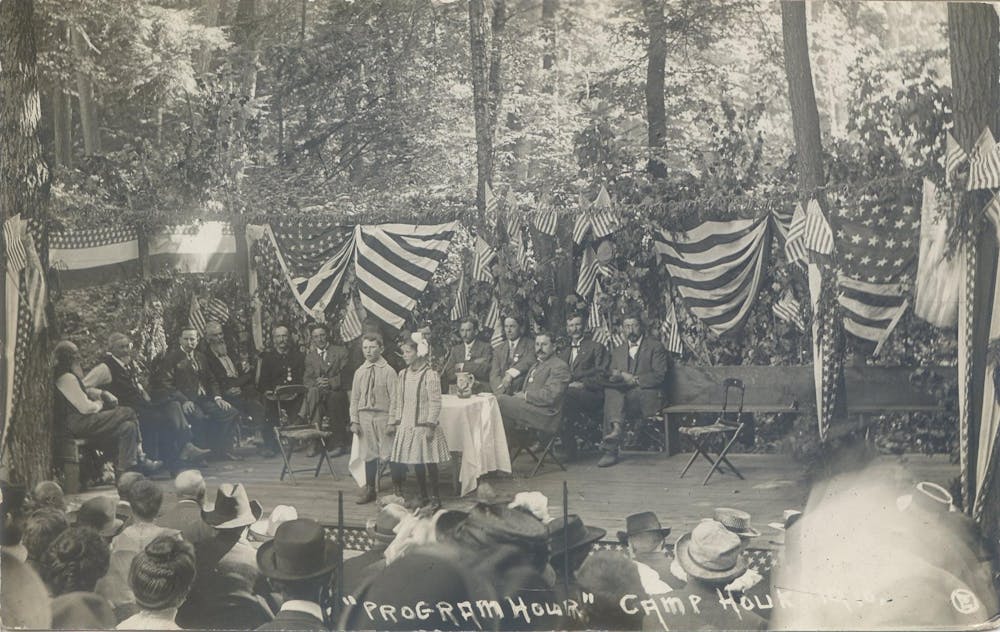
Last week, we examined Camp Houk, focusing on how I, a beleaguered teenager in 2015, spent a beautiful day there and its current significance in the county. How about this week we share in my favorite activity, imagining ourselves in the same place, 40 acres of a beautiful hardwood forest in Elbridge Township, over 100 years ago?
It is late August 1906. Camp Houk, the reunion ground for Union Army Civil War veterans, is in its heyday 20 years after it was first established in 1882, and it purportedly outshines the county fair each year. You are a teenager living in Oceana County, and you are trying to convince your mother to let you go visit the camp. Your chores for the day are finished, or you’ve convinced a neighbor not attending camp to do them for you. It’s late August anyway, and few, if any, crops are ready for harvest now.
Your mother asks first, of course, "Who's all going to be there?" Well, for starters, the veterans, who were sponsored and hosted by the organization Grand Army of the Republic (GAR). They return to the grounds every year for the sake of camaraderie, nostalgia and to support each other as the years between them and the war multiply. Many personal anecdotes from the time remark on the soldiers huddling around in their designated GAR tent, swapping war stories and reliving their harrowing experiences.
Besides the veterans, you’re likely to see plenty of your neighbors, and quite possibly their whole extended families. You may even meet up with your extended family at Camp Houk. After all, the grounds were a frequent meet-up for family, school and club reunions. You might even hope that your grandpa or uncle will offer you a space in the tent with the rest of the family, crowding as many as eight individuals under one muslin roof. Better hope it doesn’t rain.
Another group you can expect showing up to camp are the Native Americans, visiting from the nearby reservation housing members of the Ottawa, Ojibwe and Pottawattomie tribes. One of the Natives is Chief Shagonabe, who claims to have been born well before 1812, and you have no reason to question him, as he certainly looks it. Another frequent Camp Houk face of Indian descent was Henry Moon, who operated the shaving tent, ensuring that the men had a barber nearby to keep them tidy for the week. One place where the Native American attendees shone was the baseball field, where they consistently showed up the other kids coming in from outside of Elbridge Township.
A better answer to your mom’s question would be, "But, Mom! Everyone else is going to be there!” Considering this, your mother asks her next question: “Well, how are you getting there?”
Camp Houk is located pretty centrally in the county, so the trek to camp is not as tedious as one might think, and there are a multitude of ways to get there. First, and most simply, you can walk. This was certainly the primary mode of transportation for families close by or folks traveling in just for the day. If you had a whole camp to set up, however, there were plenty of wagons to take, and by 1916, even a bus route traveled to the grounds. Fairly early on in the camp’s history, a deal was struck with Hart Cedar and Lumber Company for use of their lumber train, which had no passenger seats, but could get intrepid visitors and their cargo decently close to the grounds.
Before your mother consents to let you go, of course, she has to ask what you’re planning on getting up to while you’re there. There’s no reason to lie in any way, as there was a whole week’s worth of entertainment to keep even the most hyperactive child occupied.
For starters, in many ways Camp Houk was like the county fair and as such offered fair games, side shows, animal trainers and even an engine-automated merry-go-round rented from Grand Rapids that cost 50 cents a ride. For 5 cents, you could visit a fortune teller, watch a moving picture or sit in the gramophone tent to listen to a record.
A naturally formed amphitheater hosted a wide variety of live entertainment, from vaudeville shows, magicians, musical performances and public speakers. At the far end of the grounds, a bowery was set up for dancing, with a capacity capable of holding as many as 25 square dancing partners. And if dancing wasn’t your style, or you were short on cash, you could search underneath the dance floor for loose change that had fallen between the cracks of the floorboards.
One of the main draws, however, was the veterans themselves, not only for the stories they offered or the drills they practiced, but also for the ways in which they displayed their "competitive spirit.” Between target shooting, drill teams, band and drum performances, foot races, horseshoe matches and even a bugle-blowing competition, the veterans of Camp Houk kept themselves busy.
Don’t forget to tell your mom that you won’t go hungry either - there’s an ice cream tent after all.
Families all over West Michigan looked forward to Camp Houk every year, from 1882 until the final meeting in 1917. Many speculate if the county fair was to blame for its ending, but the two coexisted for decades without competition (well, some competition, as Camp Houk had an ice cream tent and a 50-cent merry-go-round after all). The reality is that the veterans reuniting were slowly passing away, leaving so few to organize and attend all those years later. Thankfully, we have plenty of firsthand accounts from children who waited all year for the reunion, and our hypothetical today is a composite of many of their favorite memories.