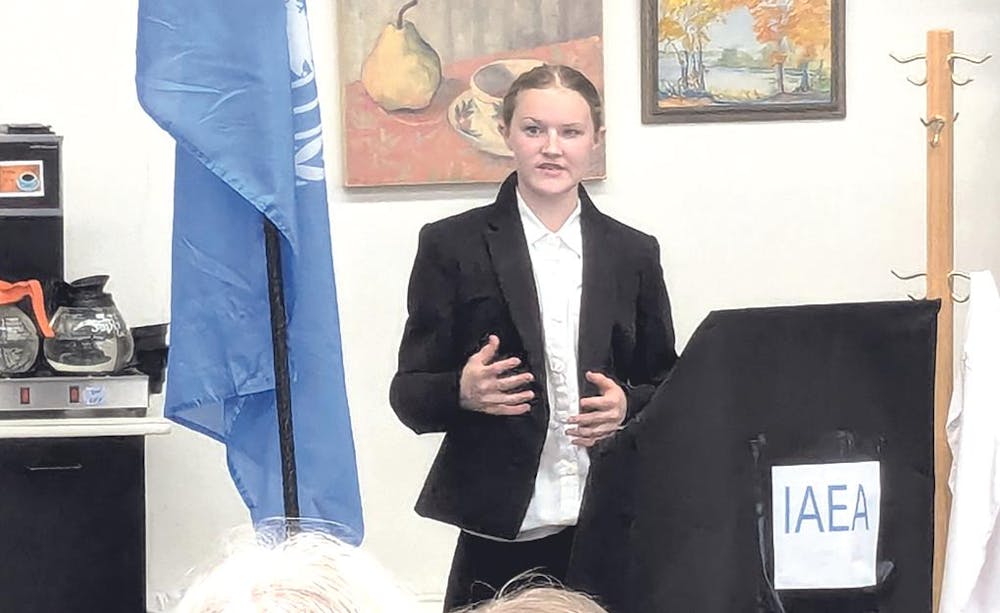
MONTAGUE — The White Lake Area Historical Society welcomed Whitehall's National History Day team state qualifiers to its first meeting of the year last Thursday at the White Lake Senior Center, the latest in what's become a traditional annual event.
Several students had the opportunity to showcase their NHD presentations, which touched on various historical topics. Some were well known, such as seventh-grader Kallie Sapp's skit dramatizing the Chernobyl nuclear facility disaster in 1986. Sapp portrayed several different people, including then-KGB Chairman Yuri Andropov, who attempted to alert Soviet authorities about flaws in the facility's construction years ahead of time, in her skit, complete with costume changes.
Some topics were less-known, such as junior Henry Chen's video presentation about the Kowloon Walled City in Hong Kong, which was originally built as a Chinese military fort but due to a power struggle between China and Great Britain over the Hong Kong territory later became a society all its own. (It was demolished in the 1990s.)
Eighteen Whitehall NHD team members qualified for the state meet, set for this Saturday, April 25 at Saginaw Valley State University. Of those, according to Whitehall NHD coach Jan Klco, nine are in the youth division, so the state competition marks the end of their seasons. The other nine will compete for a spot at the national event in Washington, D.C. in June. Klco said any NHD qualifiers to the national meet will stay at the nearby University of Maryland.
This year's NHD theme, Klco said, was revolution, reaction and reform in history, a wide-ranging enough topic that it enabled exploration of many different events, hence Sapp and Chen's presentations.
Sapp's and Chen's were the first two of five presentations that were performed at the meeting, in addition to several visual displays that were presented, with their creators fielding questions from meeting attendees.
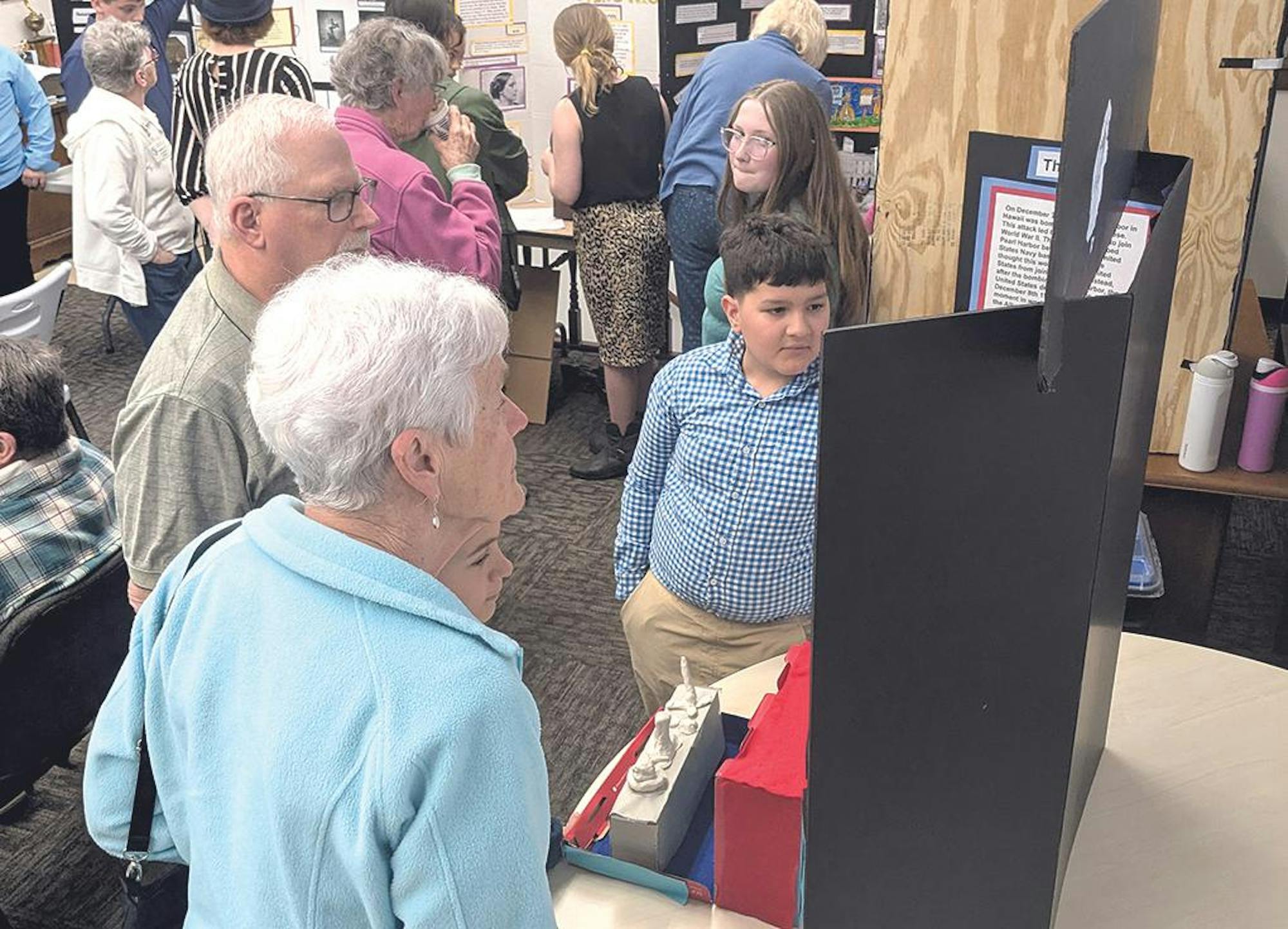

Mathilda Morneau gave her presentation about religious liberty leader Roger Williams, who was cast out of the Massachusetts Bay Colony by its Puritan leaders for his advocacy of separation of church and state, among other beliefs. Morneau noted Williams' founding of a safe haven for those seeking religious liberty away from the Puritans - an area that later grew into the state of Rhode Island.
Next was sophomore Izzy Causie, who like Chen wasn't at the meeting due to other obligations. Klco presented Causie's website on her behalf; Causie, Klco noted, took second in the national competition in the same category two years ago as an eighth-grader. This year, Causie produced a website examining the invention, adoption and effects of the three-point seat belt, invented by a Volvo engineer in the 1950s. In presenting Causie's website, Klco noted that adoption of seat belt use took decades to become commonplace as many did not originally want to use it. Mandatory seat belt laws were not instituted until 1984, when New York did so, according to an MSN article, and at that point under 20% of drivers were using them.
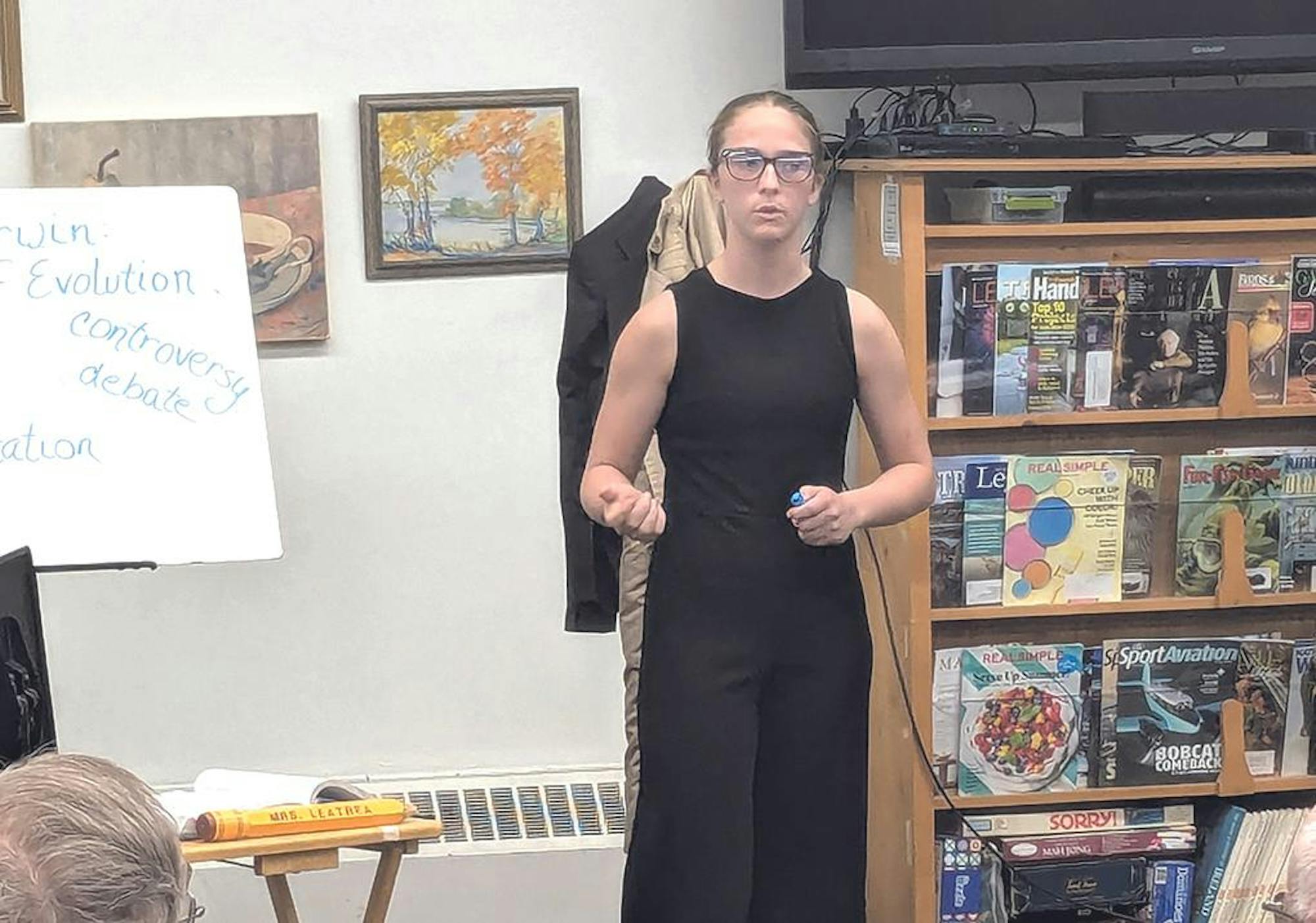
The final presenter was eighth-grader Katie LeaTrea, who employed a similar style of presentation as Sapp, portraying characters and presenting some of her facts in the style of a teaching lesson. LeaTrea's topic was Charles Darwin, and she titled it "The Revolution of Evolution." In it, she went over several key historical signposts on the topic of evolution and its use in scientific study as well as the classroom, including the 1860 Oxford debate that prominently featured Thomas Huxley, a scientist, and Anglican bishop Samuel Wilberforce. She also discussed the famous Scopes trial in which Tennessee teacher John Scopes violated a state law banning the teaching of the theory of evolution in schools.
Visual presentations on display included ones examining the 1773 Boston Tea Party, the fight for women's suffrage in the early 20th century, the fight for better working conditions in factories in the early Industrial Revolution, and more.