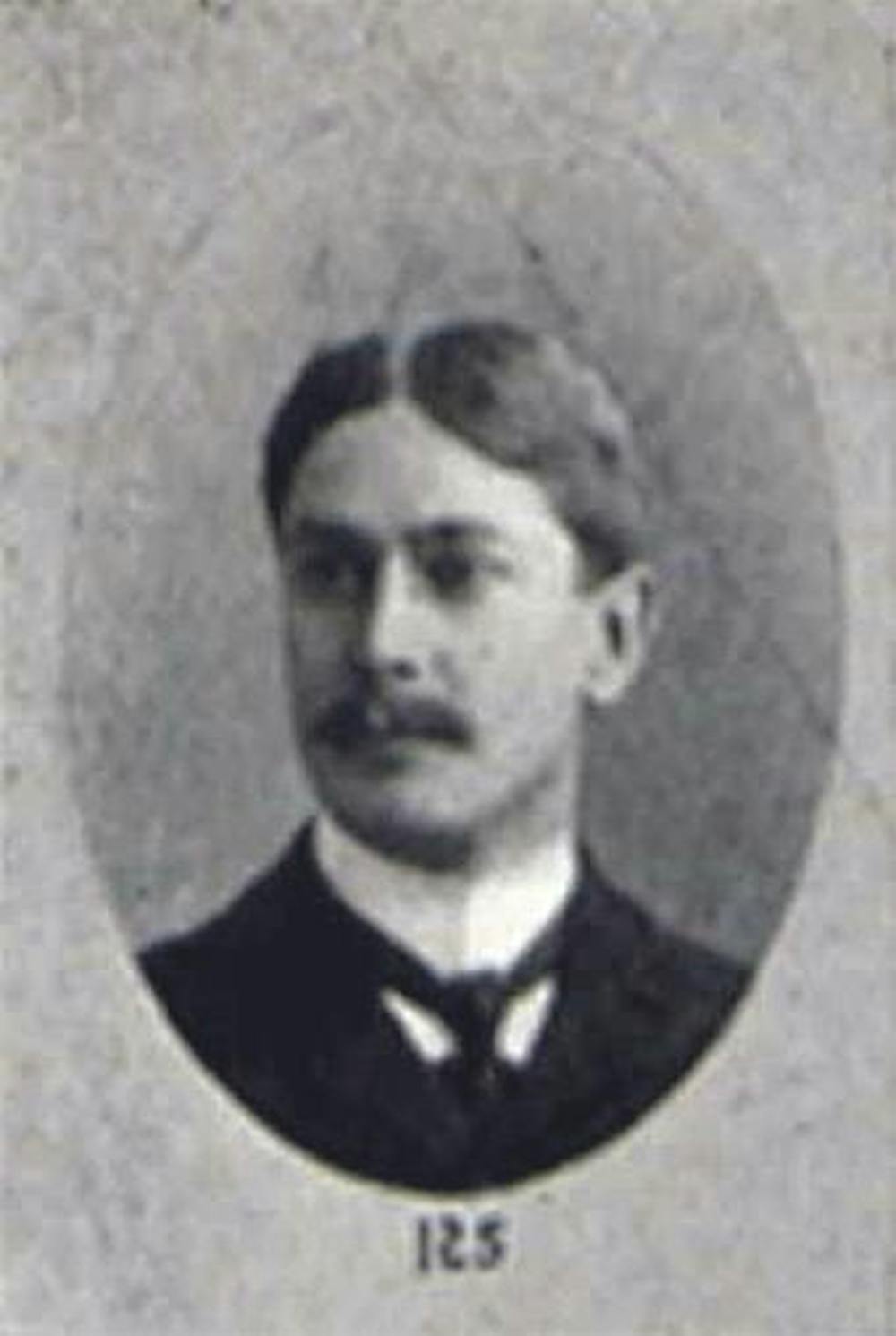
Otis White Sedgwick was born in Palmer, Massachusetts, Feb. 24, 1873, the second son of Butler and Minerva Sedgwick. He enrolled at Brown University in 1896 and excelled as a student-athlete, being noted as a talented pitcher for the baseball team. Serving as captain in 1898, he led the team to its second championship in the past three years.
Otis failed to graduate from Brown University, and on Oct. 2, 1899, at Boston, Massachusetts, enlisted in the Hospital Corps with a Captains rank. His military career was short lived as on April 19, 1900, he received a dishonorable discharge while serving at the Walter Reed general hospital in Washington, D.C. for disobeying orders and being absent without leave.
The athletic capabilities held by Otis apparently served him well as in September 1902, he found himself as the head coach of the University of Alabama football team. He received a telegram calling him to his parents’ home due to his father being seriously ill. Otis departed for Massachusetts and did not return to Alabama. He enrolled in the University of Vermont in 1902 and graduated with a degree in medicine in 1904.
Otis bought out the medical practice of Dr. E. F. Ross in Wales, Massachusetts in 1905. It is believed that his father suffered from a stroke in September 1902, and it is probable that Otis stayed geographically close to help with his care. Butler Sedgwick passed away June 22, 1906, relieving Otis of any further obligations or responsibilities.
The years following the death of his father found Otis moving around quite often. A 1916 letter from the Methodist Church in Snow, Maryland, informed the family of his current location. In 1916 or 1917 Otis answered an ad placed by Dr. George L. Kilbourn looking for a young physician to care for his practice in Forestport, New York, while he underwent an operation. Dr. Kilbourn found Otis to be a likeable physician of more than ordinary talent. It was this occasion that allowed 44-year-old Otis to meet 27-year-old Luverne Irene Kilbourn, the daughter of Dr. Kilbourn. Luverne fell in love with Otis, and after a short courtship was enticed to come with him to Alva, Oklahoma, where they were married March 27, 1917.
Residing in Alva, Luverne gave birth to their first child, Ruby Sarah, who was born in 1917, and their second child, Gordyne Lucille, who was born Feb. 25, 1919. Otis filled out his World War I draft registration card Sept. 12, 1918, even though he had previously been dishonorably discharged from military service. The registration card listed his permanent home as Alva, Oklahoma, but listed his place of employment as Crystal, West Virginia, as the company physician at the Crystal Coal and Coke Co. This information leads one to believe that his wife was living in Oklahoma while he worked in West Virginia.
There were occasions where Otis would tell Luverne he wanted to go away for treatment back east and would return about a month later looking somewhat worn yet the same pleasant, likeable gentleman. Each time he returned from one of these journeys he insisted on moving to a new town. The family eventually learned that Otis “knew when hate, murder, and madness were about to rule his whole being, and he would go to an institution until the spell ended.”
Otis returned from one of his “spells” and decided to move to a town in Michigan called Whitehall. The Dec. 18, 1919, issue of The Whitehall Forum (the local newspaper of Whitehall, Michigan at the time) announced that “Dr. T. J. Hutton had sold his medical practice to O. W. Sedgwick who will commence practice the first of the week.” Dr. Sedgwick was a general practitioner with a special interest in eyes, ear, nose and throat. Additionally, he specialized in fitting glasses.
Otis operated his practice normally, addressing medical issues as needed, with some of the citizens taking note that he had a quiet personality and was a man of very few words. Luverne was an accomplished woman from a prominent family and was a trained singer. She became involved with the Methodist Church in Whitehall, singing in the choir, and was a member of the White Lake Unity Club.
Wednesday, Sept. 15, 1920, was a day no different than any other day to Frank Hurd as he prepared to walk to his job at the local tannery in Whitehall. Frank walked along Mears Avenue towards his destination, nearing the residence of Otis Sedgwick. He noticed two human bodies lying in the front yard of the residence, and after a quick investigation determined that both bodies, a child and an adult woman, were deceased. Frank recognized them as Luverne Sedgwick and her three-year-old daughter Ruby. Frank immediately went to the authorities.
The authorities quickly arrived on site and verified what Frank had reported. They entered the house to find Otis slumbering near his other daughter, seven-month-old Gordyne. When Otis was aroused and informed about his wife and child, he blankly stared at them and remained mute even after repeated requests for information. Otis was arrested on suspicion of murder by strangulation of his wife and daughter, and what followed was one of the most stunning crime dramas in Whitehall history.
Lodged in the County jail for several days, Otis remained mute and would not eat any food, violently resisting efforts to force feed him. Other inmates claimed that when Otis was being watched he maintained the stuporous condition shown to investigators, but when he thought he was unobserved he would “pace nervously” and that “He’s like a wild beast” making noises that resemble the snores of an animal.
An inquest was held in Whitehall Sept. 20, 1920, and it brought in a verdict that Luverne Sedgwick and daughter Ruby Sedgwick came to death by strangulation by Dr. Otis W. Sedgwick while insane. The crime was placed between 11 p.m. Sept. 14, and 5:30 a.m. Sept. 15. It was believed that a struggle took place in the house and that the woman escaped with the child only to be caught on the lawn by the deranged husband.
His food strike caused concern for his health therefore, Otis was transferred to the State Hospital in Traverse City, Michigan, for treatment Sept. 21, 1920. It was claimed by the doctors there that Otis told them he remembered nothing of the crime. The doctors also claimed that he was unaware that his wife and daughter were dead until they informed him. He was transferred back to the County jail Oct. 13, 1920, looking healthy and appearing normal, to await his arraignment.
The murder trial of Otis Sedgwick was held Saturday, Dec. 4, 1920. During this proceeding three physicians were placed on the stand for testimony. Dr. George L. LeFevre, Dr. Samuel A. Jackson, and Dr. Henry Pyle held similar opinions based upon their evaluations of Otis Sedgwick that he suffered from a mixed type of insanity that at times was the manic type, but at other times passive. The disease, they stated, was always present, however.
Evidence was presented during the trial that was telling. Reports from the institutions that Otis Sedgwick had voluntarily admitted himself were found in the Sedgwick residence. These told of mental disarrangements suffered since 1904, and that he had, on former occasions, refused to eat or speak, similar to the behavior exhibited after his arrest. Letters were also found in the residence that were authored by Hubert Sedgwick, brother of Otis, to Dr. George Kilbourn imploring him to remove his daughter, Laverne, from her situation.
Letters to Luverne from Hubert were found that pleaded for her to leave the marriage. These letters from Hubert were sent because he had observed Otis suffered from periodic spells of insanity since he was a small child. This observation was verified by Anna M. Burns, who was the aunt of Luverne.
During the trial Otis remained at the side of his counsel with his head down most of the time, seemingly taking little interest in the proceedings. No testimony was made as to the crime itself, and no arguments were made to the jury. Based upon evidence presented, the jury, after one hour of deliberation, returned a verdict of insane. Otis showed no emotion at the announcement of the verdict.
Judge Vanderwerp immediately made an order committing Otis to the Ionia State Hospital for the criminally insane. Upon bidding good-bye to the officers in the courtroom, Otis completely broke down, showing emotion for the first time since the tragedy. Otis White Sedgwick spent the rest of his life in prison in Ionia where he died Aug. 23, 1945, at the age of 72. His remains were interred in the family plot at the Four Corners Cemetery in Thorndike, Massachusetts.
Gordyne was initially cared for by a neighbor, Mrs. Mark Covell, until Blain Kilbourn, brother of Luverne, arrived to bring the bodies to New York for burial in the family plot. She was then taken to Forestport, New York, where she was raised by her grandparents and had a fulfilling life. “Dyne” married Carl N. Jensen July 30, 1948, in New York, and they had three children. She died from dementia at her home in Greenwich, Connecticut, March 4, 2011.