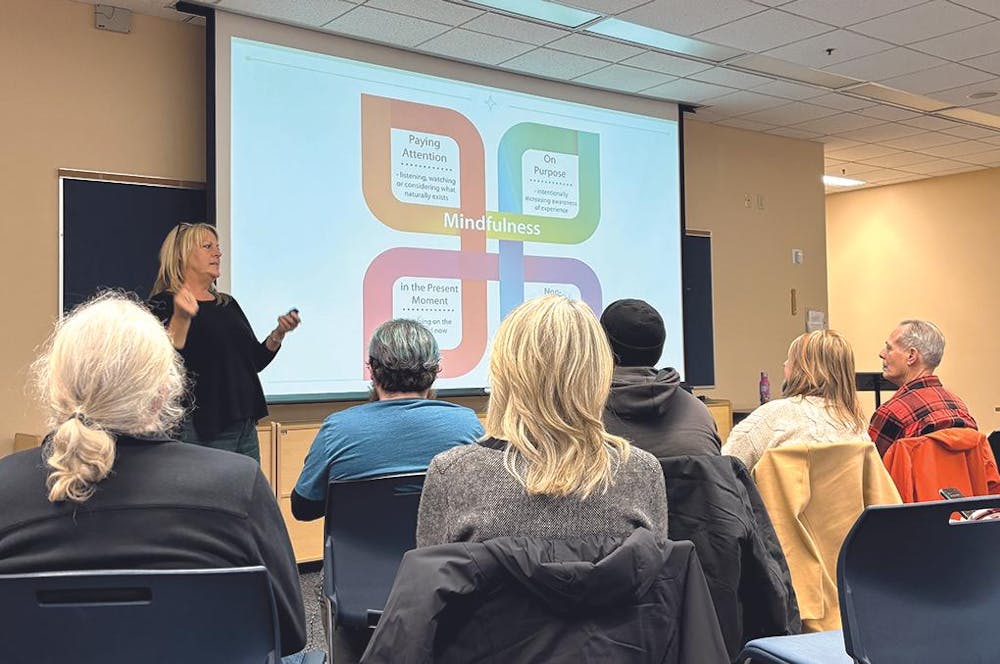
WHITEHALL — Common Ground Community of White Lake hosted a program about mindfulness and navigating emotions Tuesday, March 3 at the White Lake Community Library.
A nonpartisan group interested in bringing together White Lake residents “together across political, cultural, and personal divides," the group has hosted several conversation programs over the past year-plus.
Sue Mack, an organizer at Common Ground, noted recent news stories in recognizing the importance of checking in with the community, especially in regards to mental health. This “checking-in” manifested through a presentation from Lisa Cobb, a licensed master social worker, in which she supplied attendees with the tools and guidance on how to look out for themselves and each other.
Cobb works in private practice with an extensive background as a social worker for Muskegon County schools, and her work relies heavily on her research into neuroscience as well as her own personal lived experiences.
“My intention is that when we leave this time together today, that we all just feel a little more uplifted and hopeful,” Cobb explained to begin her program, “[that] we all feel like we’re seen and heard....We are currently living history, powerful and transformational events."
Of the impact of such stressors that are out of our control, she describes symptoms of chronic exhaustion, disrupted sleep, appetite changes, weaker immune systems.
“Our brains are wired to see change as a threat," Cobb said. "We’re constantly assessing our environment…Our bodies react to that stress. Even when there’s no physical threat, our bodies still see it as a danger.”
Much of what Cobb emphasized was body awareness and being present, leading attendees in breathing and meditation exercises at the open and close of the presentation. She acknowledges that seemingly simple exercises can be difficult, referencing studies that claim, on average, our minds are distracted 47% of the time, and our brains are inundated with 70,000 thoughts per day. It takes practice and exploration to be mindful, but she believes anyone can do it. Self-awareness helps you learn to regulate yourself and react. Cobb advises being present and patient with yourself.
Another large portion of Cobb’s presentation centered on discussions of certain parts of the brain - the prefrontal cortex, amygdala, and hippocampus - how they analyze information and regulate stress. In particular, learning about these functions personally helped her through fraught periods during her time as a social worker and inspired her to integrate them in her work. Many of the models Cobb presented were the same techniques she used with students, teachers, and parents in schools to provide understanding of stress responses.
“When we know, 'Oh, that’s what’s happening in my brain,' then we can begin the work of calming our bodies down," Cobb said.
Near the end of the presentation, Cobb brought the conversation back full circle to our community, and how we can look out for each other while also providing peace for ourselves.
“Love is the power that cuts through fear," she said. "Community is the power that we’re returning to…[Saying to someone] ‘I don't know you on a personal level, but I care about you, and I want us all to get through this together.'"