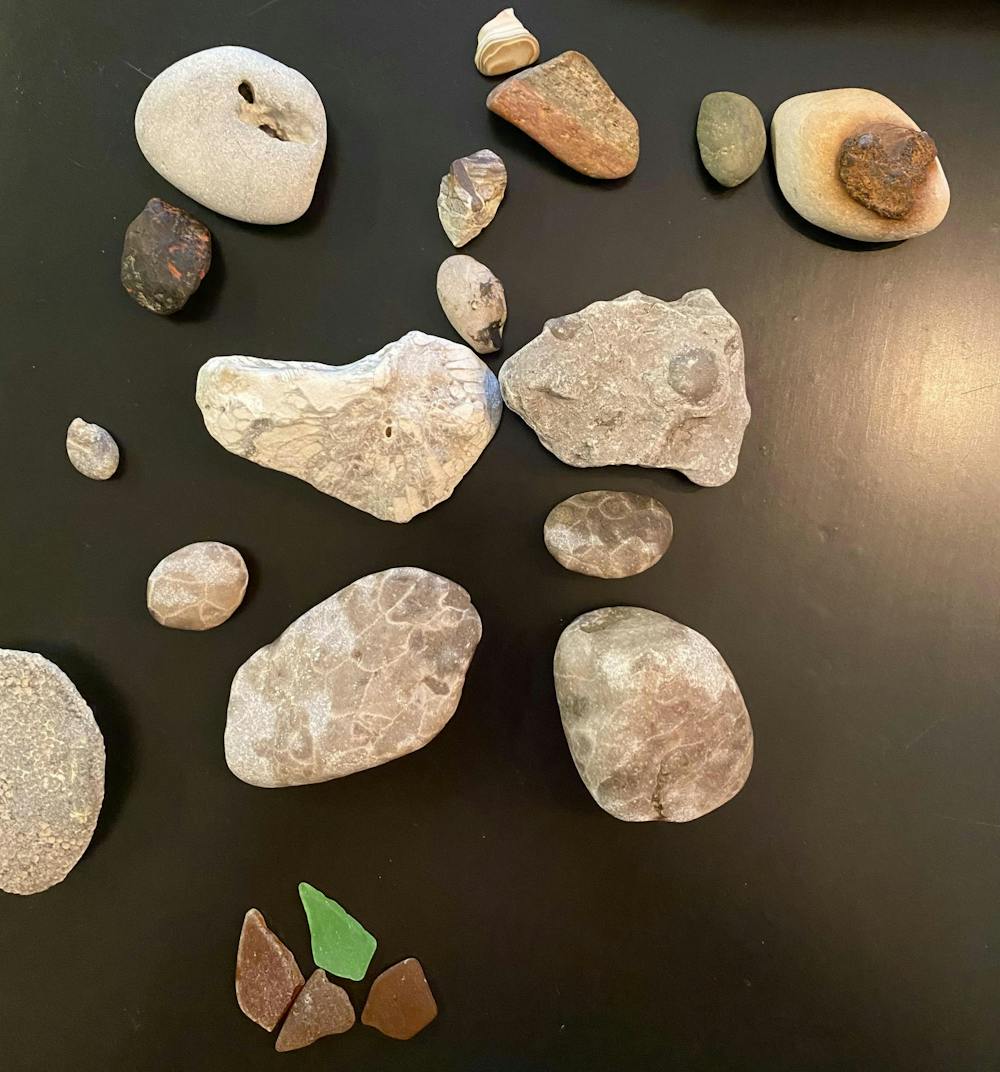
It’s craft fair season! I think many of us can agree that we each have a favorite booth we like to check out - crochet, wood carvings, those upcycled beer-bottle wind chimes with Detroit Lions decals printed on the side. For me, I beeline straight away to the jewelry tents, particularly those that are made from Michigan beach finds. To say I like rocks is an understatement. A better statement is that I have an ever-growing collection of rocks that makes moving a pain in the neck. Among that collection includes a dozen Petoskey stones that I’ve found myself beachcombing up north, a very enviable collection for a non-retiree without a lake cottage, if I do say so myself.
But there’s far more than just beach glass and Petoskey stones on Michigan beaches to discover. Our great state has a wide variety of stones (and “stones”) unique to us. So, this week, let’s talk rocks - maybe even instigate some fights by giving them arbitrary scores based purely on vibes.
Isle Royale Greenstone - Also known as Chlorastrolite, these are officially designated as Michigan’s state gemstone. They range in hues of moody green-blues with white fractal patterns, like turtle shells or cracking ice. They were formed during the Upper Peninsula’s volcanic past 1.1 billion years ago and polished into round little pebbles of gravel by millions more years of Lake Superior waves. You can find them on the Keweenaw Peninsula and, as the name suggests, on Isle Royale - however, you cannot remove them from the latter as it is a national park.
Score - 9/10. They’re my favorite color, and I love the patterns (anything associated with turtles garners extra points), but minus 1 because they aren’t very big and I spent a very long summer vacation trying and failing to find them in the UP.
Yooperlite - A recent addition to the Michigan Rock-Hunters list, discovered in 2017 by Michigander and gem dealer Erik Rintamiaki after shining ultraviolet light on a rather innocuous grey rock. These syenite rocks are grey with dark speckles (sodalite deposits) until you shine your UV flashlight (which, of course, everyone has on hand), and their speckles glow a bright fluorescent orange. You can primarily find Yooperlite on Lake Superior beaches, but they’ve been known to show up all around the Great Lakes.
Score - 6.5/10. They look like magma or dragon eggs, but only under UV light! Why does my rock hunting now require extra steps? I mean, I guess there’s a metaphor in there somewhere about how something that seems unassuming can shine in the right circumstances?
Lake Superior agate - Considered some of the world’s oldest agates and also a relic of the UP’s Mesoproterozoic volcanic hotbed, Lake Superior agates are notable for their bright orange, red and white bands of color. Again, going by the name, Lake Superior agates can be found on the shores of Lake Superior as well as in glacial deposits throughout the Midwest.
Score - 8/10. Lake Superior agates come in a variety of patterns and each one looks like a satellite image of the surface of Mars. Minus 2 because I couldn’t find any of these either during the same vacation as described above for Isle Royale Greenstone. I’m starting to wonder if I should try again, but this time with a little more patience than when I was 11.
Michigan Puddingstone - A conglomerate stone consisting of quartz and jasper, this hodgepodge of rocks smooshed together was named as such because it resembles fruit pudding. I don’t recommend putting them in your mouth, though. There are a lot of varieties of puddingstones and an even greater variety of conglomerate rocks throughout the world - but these are ours. Well, ours as well as pockets of Ontario. These rocks are more likely to be found in glacial deposits or mines rather than on the coastline, with notable deposits found on St. Joseph Island and Drummond Island.
Score - 4/10. Not my style, sadly, but I respect the hustle of rocks stuck to other rocks.
Leland Blue Stone - These are NOT natural gemstones but an industrial byproduct (also known as “slag”) resulting from iron smelting. They’re blue, of course, with patches of white and rusty red, and were produced in great quantities in Leland during the operation of the Leland Lake Superior Iron Company from 1870 to 1884. While not necessarily au naturale (but still a perfectly valid chemical reaction), that doesn’t negate how precious Leland Blues are to rockhunters across the state.
Score - 7/10. Listen, I am easily swayed if the rock is pretty enough. I don’t care if it is the result of Victorian-era industrial pollution rather than volcanoes!
Fordite - If the Leland Blues upset you, then Fordite will send you into a blind rage. Fordite is another example of industrial slag, this time in the form of hunks of enamel car paint cut and polished to look like an agate. They’re popular “rocks” to make jewelry out of and, due to levels of lead in the paint, cannot be sold in California.
Score - 7.5/10. I think it's neat to have a little time-lapse of the different colors of the automotive industry that's also slightly toxic.
Petoskey stones - I hope I’m not spoiling my final ranking by saying I’ve saved the best for last. Famously known as Michigan’s state stone, Petoskeys are the most organic on this list, made from fossilized coral and ground up by the momentum of glaciers across the state during the last ice age. Petoskeys are a grey-brown color, dull when dry, but reveal a honeycomb pattern when wet or polished. They’re primarily found along the beaches of northwest Michigan, particularly after a storm or during the spring thaw and are a favorite of jewelry makers across the state.
Score - 10/10. How can I deny our most iconic rock a perfect score? I’ve got several, highly complimented pieces of Petoskey jewelry that ensure I always have a little piece of home no matter where I go.