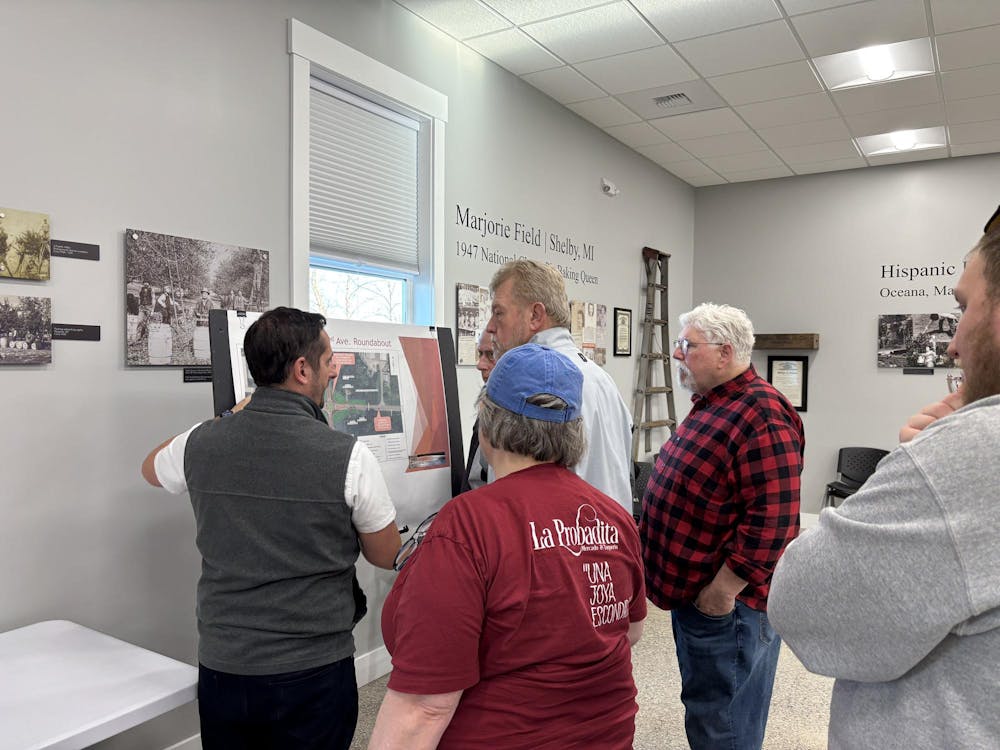
This past Tuesday, April 21, the Oceana County Road Commission (OCRC) held a public informational meeting regarding their most recent and divisive project announcement, a total overhaul of West Polk Road in Hart, complete with a traffic circle (roundabout) located at the intersection of 72nd Avenue. Upwards of 100 county residents packed into the event space of the MSU Extension's West Michigan Research Center to attend the meeting, showing a wide spectrum of emotion and approval over the announcement.
The sizable crowd was remarked upon by OCRC Highway Engineer Cole Shafer, who expressed how “amazing and awesome” it was to see so much interest in the project.
Shafer went on to introduce the presentation with an overview of the project’s scope, which encompasses all of Polk Road from 64th Avenue to Oceana Drive. While the roundabout is the most prominent feature of the project, also included is the addition of a center turn lane, improvements to the Hart-Montague Rail Trail crossing, and the reduction of a blind spot by Parmington Avenue.
Currently, Polk Road consists of two lanes, both 12 feet wide, with shoulders measuring the same width. The new 3-lane configuration would still feature 12-foot lanes, though now with 8-foot shoulders. The center lanes are also planned to span from 56th Avenue to State Street.
A final design for the project will be made in fall of this year, with construction anticipated to start in spring of 2027 and finish by the fall of that year. Shafer assured attendees that the road commission was taking every measure possible to reduce the impact on Polk Road businesses throughout the construction period. Rather than segmented road closures, traffic will be maintained in the lane opposite of whichever one is being constructed, with detours to the opposite-bound traffic. The road commission will also construct temporary drives to maintain access to business throughout the length of the project construction. Side streets will be closed and detoured, depending on the stage and location of construction. The anticipated first lane closure will be that of eastbound traffic.
Shafer then passed the presentation on to OCRC Managing Director Mark Timmer to explain the decision to install a roundabout at the Polk Road and 72nd Avenue intersection. He stated that the planning started when OCRC finalized their turnback agreement for jurisdiction over Polk Road, which had been an MDOT-maintained road for decades. As it stood before the turnback, MDOT was uninterested in making any meaningful improvements to enhance the safety of the road, despite requests by the county to do so.
As Timmer explained, the opportunity to turnback Polk Road from MDOT and make those necessary changes outweighed the pushback they’d likely receive; “I knew there would be some opposition to it, but I know it's the right thing to do.”
For Timmer and the OCRC board of commissioners, that “right thing” is a roundabout.
Funding for the entirety of the Polk Road project is provided by $6,024,357 from MDOT as part of what was included in the Polk Road turnback agreement, alongside a safety grant of $750,000 awarded for the roundabout. In the case of the MDOT funds, they can only be used for Polk Road improvements and must be used by 2030, or else the funds revert back to MDOT.
Anticipating criticism, Timmer addressed many of the talking points that have circulated social media over the past few weeks following OCRC’s press release. As for why the answer to the Polk and 72nd intersection is a roundabout rather than a traffic signal, Timmer explained that the intersection does not meet any of the federally set standards that would allow the installation of a signal, leaving a roundabout as the only option. Lowering the speed limit is another non-starter, as, due to the average speed of 85% of vehicles traveling the road, the likelihood that the limit is allowed to stay the same, or even increase, is quite high.
“So what we’re going to do is we’re going to make traffic-calming measures,” Timmer said.
Those measures include a roundabout, which would not only slow the speed of traffic as it moves through the intersection, but also improves the flow of traffic by creating fewer conflict points between vehicles and simplifies decision-making as all vehicles turn the same way.
Semi-trailer traffic has also been taken into consideration by OCRC, as the roundabout will be constructed wide enough to accommodate those vehicles, with the addition of a truck apron at the center of the circle, which is designed to provide extra road space for trailers, as well as accommodate their added weight.
For Timmer and many others, however, the greatest factor in favor of a roundabout is that of safety. One key case study Timmer considered was that of the intersection of M-37 and M-46 in Muskegon County, which saw the 4-5 annual fatalities reduced to zero after the installation of a roundabout in 2012. “So if you take 13 years of 4 or 5 people a year dying, that’s 50, 60 people that are alive now because that roundabout went in,” explained Timmer.
Nationwide, the implementation of modern roundabouts decreases the likelihood of serious accidents by 82%.
Also presenting for the road commission was Oceana County Sheriff Craig Mast. “I’m trying to stay in my lane, and my lane as county sheriff is safety and security,” he explained while handouts were distributed to the audience of accident statistics from the past 10 years on Polk Road.
In the past 10 years, 426 crashes took place on Polk Road - plus one, as an accident had occurred that very afternoon. At the Polk and 72nd intersection alone, there were 57 accidents, with 59 more by Hansen Foods and Rennhack Orchards Market, where a slight hill causes a considerable blind spot. In the past decade, Oceana County has been fortunate enough to see no fatal accidents on Polk Road, though that has not always been the case.
Said Mast, “I have looked at the statistics for the different forms of traffic control… I like to make decisions on data… The current data reveals that a traffic circle is, by far, the safest remedy for an intersection of this nature. There’s other options, there might be cheaper options, but the current data reveals the traffic circle is what’s safest. And that’s where my concerns are.”
Mast said he is not only in favor of a roundabout, but also sees benefits in the reduction of the blind spot and addition of a turn lane, the latter of which would decrease the amount of drivers who cross the solid white line to pass cars on the right.
Comment cards were made available to the audience, with the intention for the road commission to create a list of FAQs for the county. Following the presentation, the public was welcomed to approach OCRC staff members to discuss and ask questions one-on-one.
Several audience members did ask pointed questions aloud during the presentation, primarily regarding the purpose of the public meeting (announced as a public hearing), whether the project was decided at an open meeting and what notice was made available to the public regarding such significant changes to the road.
Many attendees remained after the presentation to ask questions regarding the project’s timeline, affected areas and impact on local businesses. This number included local government officials and City of Hart council members, who have already fielded questions regarding the project despite the city having no jurisdiction over the road. Visuals were also provided to illustrate the new lanes and construction details.
Despite some vocal opposition, many attendees approached OCRC staff enthusiastic about the project and the planned improvements.
For Timmer, OCRC and the board, the decision was made in the interest of public safety. His final thoughts on the matter were, “Remember, roundabouts save lives.”