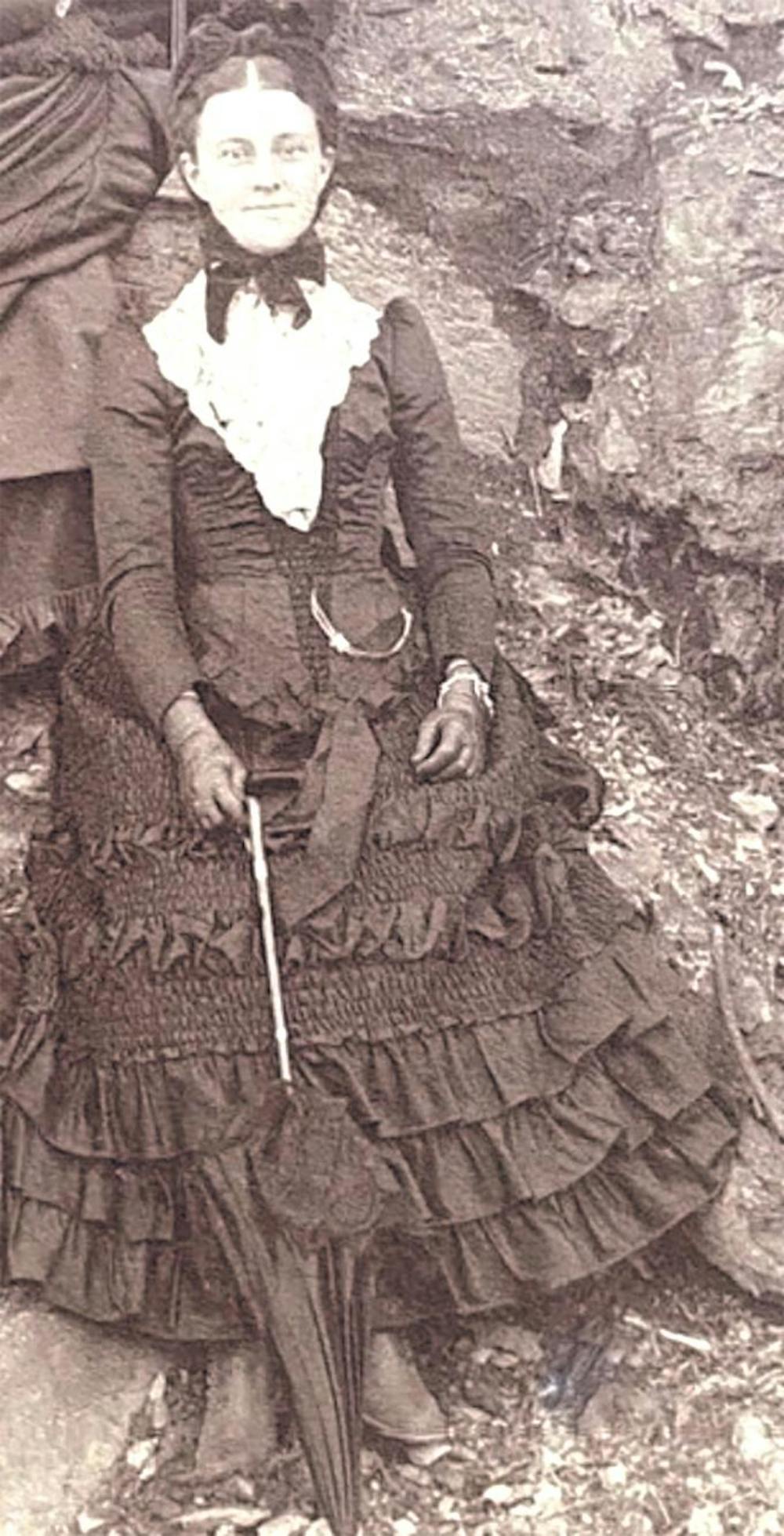
Annie Wilson was born in Scotland to William Wilson and Catherine (nee Carlyle) Wilson. The family unit was comprised of the parents and 3 children: Robert (born 11/21/1841), Elizabeth (born 5/9/1843), and Annie (born 10/4/1848).
William Wilson embarked on a journey to the United States from Liverpool, England, in 1848 on the ship “Georgiana” with the intent to seek his fortune and then bring his wife and children over soon after. During the voyage the ship encountered a fierce storm and sunk to a watery grave, with no survivors. Catherine, hopeful for word from her husband, waited for a year and then accepted what the cruel hand of fate had delivered to her. Knowing her children would have little to no memory of their father, she faced her situation bravely, and in 1849 she and her children voyaged to the USA.
The family had made it to the eastern seaboard but that was not their destination. They continued their voyage to Grand Haven, Michigan where they were met and befriended by Reverend William Montague Ferry. This meeting was probably the most favorable stroke of fortune that Catherine could have experienced at this time in her life since William Ferry was one of the most influential individuals in the State of Michigan.
The family engaged the last leg of their journey to Courtland Township, Kent County, Michigan to settle with John and William Carlyle, who were brothers to Catherine. John and William had established farms in Section 33 and 34, and when Catherine arrived her family was split apart. The 1850 Michigan Census for Kent County showed that 27-year-old Catherine and 3-year-old Annie were part of the Philo Beers household, 6-year-old Elizabeth was living with John and Maria Brewer, and 9-year-old Robert was in the John Carlisle household. This family split was not that significant since they were geographically close to each other and could see each other quite regularly.
The 1860 Census of Kent County showed that Robert had taken up residency with Aaron Beman Turner in the third ward of the city of Grand Rapids and was a printer’s apprentice. Aaron Turner was the owner and editor of the Grand Rapids Eagle and in 1872 would become Robert’s father-in-law when his daughter Ellen married Robert.
Catherine and 12-year-old Annie were residing at the Brooks Hotel in Newaygo, Michigan, according to the 1860 Michigan Census, where Catherine worked as a cook. It is probable that Annie learned a good deal of information at this place of residence that would serve her well in the future. It is unknown where 17-year-old Elizabeth resided at this time, but she would marry Samuel Hart Row on Sept. 14, 1863 in Sharon, Washtenaw County, Michigan, and spend her life living in Lansing, Michigan.
The Reverend Ferry, his son Edward, and George Dowling as resident manager established the Ferry Dowling & Co. sawmill at the head of White Lake in 1865. Shortly thereafter a town was surveyed and aptly named “Montague.” Settlers started moving to this area and by 1870 more than a dozen homes had been erected.
The 1870 Census showed that at some point in time between 1860 and 1870 Catherine and Annie moved from Newaygo, Michigan to the newly established settlement of Montague, Michigan. Catherine was boarding at the residence of James Santon and gave her name to the census taker as Mary Catherine Wilson, and that she was retired. No record of Annie was found in the 1870 Census, but there was a 20-year-old Scottish born woman boarding at the residence of J. D. Pullman named “Annie Walton.” It is possible that this woman was Annie Wilson, and that when she responded to the census taker in her Scottish accent it was heard and written as “Walton.” Additionally, the residence of J. D. Pullman was a mere three blocks from Annie’s place of employment, the Ferry Dowling & Co. boarding house.
There is a photo of Annie Wilson in 1870 standing in front of the Ferry Dowling & Co. boarding house. It is the author’s belief that she was employed by the lumbering firm to provide domestic services to the boarding house tenants as she appears in an apron that is reminiscent of a cook. It is also the speculation of the author that she was fully qualified for such a position since she most likely assisted her mother with similar endeavors when they resided at the Brooks Hotel in Newaygo.
Additionally, it could be possible that the Reverend Ferry, due to his friendship with Catherine, encouraged her to move to Montague where a job was provided to Annie in the firm’s boarding house. The Reverend Ferry passed away Dec. 30, 1867, so if this theory is true Catherine and Annie would have moved to Montague sometime between 1865 and 1868.
Annie’s move to Montague allowed her to meet George Enoch Dowling, the resident manager of the Ferry Dowling & Co. firm, and on Saturday, April 10, 1875, they were united in marriage at the residence of her sister, Elizabeth Row, in Lansing, Michigan. The 26-year-old Annie Dowling had just wed one of the wealthiest men in the White Lake area and the firm subsequently made the decision to shut down the boarding house in which she worked. On May 20, 1875, they moved into the handsome home that George built, and she assumed the duties of “keeping house.” Annie must have marveled at her good fortune and felt like her life was going in a positive direction, and indeed it was as on May 16, 1876, she gave birth to her first child, John William Dowling, who was referred to as “Willie.”
Good fortune can be as fleeting as a wisp of smoke on a summer breeze, and Annie had no idea what a roller coaster her life would become as on 19 November 1878, her brother Robert passed away presumptively due to wounds sustained during the Civil War. Robert probably served as the only father figure Annie had during her youth, and his death was most likely an emotional blow to her.
After the death of Robert a few years passed in relative comfort where George pursued his business interests and his duties associated with the Masonic Temple, and Annie spent her time raising their child and keeping house. On 19 May 1882, three days after Willie’s sixth birthday, Annie and George were devastated by the death of their only child due to what was noted as malarial fever. The loss of their child was only part of the tumultuous occurrences in their lives as the business firm of Ferry Dowling & Co. experienced financial challenges which caused George to exit the partnership.
Annie’s mother Catherine moved in with them in the mid 1880’s perhaps to provide Annie with some companionship since George was quite busy with a variety of business ventures that took him out of town frequently. Suffering from illness in March 1888, Catherine opted to move to the sanitarium in Battle Creek to take advantage of the benefits found there, and by 1889 had indeed benefitted to the point that she was contemplating a return to George and Annie, but unfortunately, she contracted as acute sudden disease and passed away peacefully at the sanitarium on 10 August 1889. Annie had just lost the person who had been with her since birth. Her only remaining original family member, her sister Elizabeth, lived in Lansing.
Shortly after Catherine’s death George continued to be busy with business and Masonic duties, plus he had just purchased 40 acres near their home with the intention of turning it into a private park which he dubbed “Buttermilk Springs.” Additionally, George found himself a defendant in several lawsuits that resulted from his association with the Ferry Dowling & Co. firm. All of these issues kept George busy, so Annie decided to get a dog. This new family member was a Newfoundland puppy which she named Prince.
Annie spent her time gardening and planting flowers around her home, turning it into a beautiful garden that many local people admired. She also spent time serving on committees associated with the White Lake and West Oceana Agricultural Society.
On Saturday night, June 21, 1890, a strong thunderstorm moved through the neighborhood and lightning struck the Dowling house, demolishing a chimney and causing other damage as well. The following morning George showed the damage to Jerome Weeks, who was their hostler and who resided in their barn. Upon seeing the damage Jerome appeared to have been thrown into a nervous strain and the following morning when he did not show up for his usual activities George checked on him and found him in his bed in a stupor. Jerome could not be roused and by Monday night had passed away.
Afterwards it was learned that Jerome had been struck by lightning about seven years prior, and upon seeing how close the lightning had struck, he sunk into the stupor. The probable cause of death was noted as apoplexy.
Jerome was not the only hired hand of the Dowling’s that met with the bony hand of death. William Schmidt had been a garden for George and Annie from about 1879 to 1889 and passed away Monday, March 28, 1892, approximately three years after becoming too infirm to continue attending to the gardening duties.
On Feb. 26, 1895, Annie and six other local women engaged in a sleighride to Muskegon to visit the Hackley Library and enjoy a mid-day meal at the Occidental Hotel. Shortly after their departure, George phoned Mr. Barney, the landlord of the hotel, to apprise him of their pending visit and provided instruction to treat the ladies as royalty. When the ladies arrived at the hotel they were escorted to the best room in the hotel and found “an elegant spread on an exquisitely decorated table.” The ladies immediately claimed that they were in the wrong room and that a mistake had been made, but the landlord assured them that everything was in order. The ladies enjoyed a splendid meal, which was followed by a marvelous visit to the library, and when they returned home that evening around 6:30 p.m. they indeed felt as if they had a royal time. This event showcased the influence that George possessed, as well as his consideration for others.
In late February 1896, George sustained a severe fall on the stone steps of Ripley’s drug store. George had been in poor health for the past two years and the accident had left him feeble and barely able to move around even after 2 weeks of rest. At 3 a.m. Monday, March 30, 1896, George died as a result of heart failure, thereby launching Annie into the most strenuous, challenging phase of her life.
Attending to the tasks associated with a funeral and burial, Annie laid George to rest next to their son Willie in the family plot at the Oak Grove Cemetery in Montague. With only a short time to grieve her loss, Annie had to address the estate of her deceased husband who had died intestate. Heirship in this case was 50% of the estate would go to the widow, Annie, and the other 50% would go to the parents of the deceased, John and Phoebe Dowling.
Determining who would be the administrator of George Dowling’s estate would not be a simple task. Annie was appointed as administratix of the estate with assistance from her nephew Hart Row as an appointed co-administrator. This action resulted in a petition to the probate court from John Dowling objecting to the appointment of Hart Row as co-administrator based upon his lack of familiarity regarding George's business activities, as well as being incompetent or qualified to administer the estate because of this lack of familiarity. The petition requested that Cassius D. Dowling, son of John and Phoebe, and brother of George, be appointed as co-administrator due to his familiarity with George's business activities. The probate court affirmed the appointment of Annie Dowling and Hart Row May 25, 1896, and denied the petition for Cassius Dowling to be appointed as co-administrator. This was the first battle in a developing war between Annie Dowling and Cassius Dowling.
Michael Brown, an attorney based out of Big Rapids, Michigan, served as the confidential and legal advisor to George Dowling for several years prior and up to the time of his death, and also served as special administrator after his death, being appointed by the probate court May 5, 1896. Mr. Brown spent considerable time with Annie after George’s death examining books and papers, discovering George had failed to enter any business transactions in his books for a period of four years prior to his death, and that his books had been meagerly kept for a period of eight years prior to his death.
It was highly irregular that George would engage in such poor record-keeping since his entire career as a businessman was based upon his meticulous attention to detail. Poor record-keeping during the final eight years of his life created a most challenging task of sorting through what records were available to piece together his total estate value. George was involved in a great deal of business activities that required considerable time and attention of the administrators. Hart Row quickly realized how demanding the role of co-administrator was going to be, and on June 22, 1896 submitted to the Probate Court his declination to qualify as co-administrator of the estate of George Dowling based upon other business engagements. Annie Dowling was now left as sole administratix of George’s estate, with assistance from Mr. Brown.
Mr. Brown suggested to Annie that she employ Samuel H. Lasley to assist her in looking after the matters of George’s estate since he was an old acquaintance and former business partner with George and was particularly well qualified to assist her in settling the estate. Annie embraced the suggestion and hired him with a $1,500 per year salary.
One of the most striking pieces of information discovered by Mr. Lasley was that numerous parcels of real estate had been purchased by George Feb. 2, 1883, from his brother Cassius Dowling for $6,400. This real estate had nearly quadrupled in value over the 13-year period prior to George’s death, but Cassius had never provided a deed or conveyance for any of the parcels. During this 13-year time period Cassius had sold some of the subject parcels to unsuspecting purchasers. Upon request from Annie to convey the parcels to the rightful owner - the estate of George Dowling - Cassius refused. Annie subsequently brought suit against Cassius to transfer ownership of the real estate, and on March 24, 1897 Circuit Court Judge Fred J. Russell ruled in favor of Annie, and that Cassius must transfer the real estate and pay Annie’s court costs. This marked the second battle between Annie and Cassius.
Perhaps as a result of the Circuit Court ruling, Cassius submitted a claim on April 6, 1897 against the estate of George Dowling in the amount of $11,175 ($405,904 in 2023 dollars) for services rendered from Feb. 1, 1883 to March 30, 1896. The claim did not specify what services were rendered and was summarily dismissed by the court. This marked the third battle between Annie and Cassius.
On Thursday, April 22, 1897, John Dowling died. His death left the widow Annie and the widow Phoebe as the heirs to George’s estate. Phoebe was in poor health and on May 4, 1897, a mere 13 days after her husband’s death, she quitclaimed all of her right title and interest in the estate of George Dowling both real and personal of every kind and nature for the sum of $1 and other valuable consideration. The transfer was made from Phoebe Dowling to William C. Dowling, Henry P. Dowling, Melvin T. Dowling, and Cassius D. Dowling, brothers to George Dowling, and also her surviving sons. This transfer legally gave each brother one-eighth interest in the estate of George Dowling and may have been suggested by Cassius after his stinging defeat in the previously mentioned lawsuit. This event would not be considered a battle, but Cassius probably felt victorious.
Cassius was not the only entity that Annie had to address. Annie filed a Circuit Court suit July 29, 1897 against the Knights Templar and Mason’s Life Indemnity Company to recover $6,000 in damages. On Dec. 10, 1890 the company insured George Dowling’s life in the amount of $5,000, and that up to the date of his death, March 20, 1896, George had paid $500 in assessments, but the insurance of $5,000 was never paid. The Circuit Court jury heard the case and on Oct. 25, 1897 rendered a verdict in favor of Annie Dowling in the amount of $5,815, and in response the defendant started planning their appeal. The case was taken to the Supreme Court to rehear the case, and on May 25, 1898 the Supreme Court denied that request. Annie received the insurance payout more than two years after George’s death.
Annie also had to initiate legal proceedings against Charles Smith and Frank Lindborg to foreclose on land contracts in Oceana County that they had respectively entered into with George. Two suits were also initiated in Muskegon County for the ejectment of George and Mary Ann Bush, and Edwy Logan Reeves to recover certain lands in which the estate of George Dowling was one half owner along with Lyman T. Covell.
On Tuesday, Dec. 14, 1897 the Dowling brothers (William C., Henry P., Melvin T. and Cassius D.) petitioned the Probate Court to remove Annie Dowling as the administratix of the estate of Geroge Dowling. The petition cited the following for grounds for removal:
1. That she was without experience or business education and incompetent and left the management of the estate to an untrustworthy and irresponsible employee.
2. That she was seeking permission to sell real estate belonging to the estate for no reason.
3. That she misled the court as to the value of the personal property of the estate, and gave an inadequate bond.
4. That one of the sureties of the bond had become insolvent.
5. That she failed to file an inventory of the estate, even though often requested to do so.
6. That she failed to file an account of her administration of the estate.
This petition was denied by the Court based upon Annie’s response noting that due to the nature of the books and papers at the time of George’s death, it took Mr. Lasley several months to obtain information related to many items belonging to the estate. The disarray of George’s books during the last eight years of his life has resulted in a great investment of time and resources to determine the extent of his estate.
The Dowling brothers submitted another petition April 13, 1898, to the Probate Court to compel Annie to file a final account of administration regarding the estate of George Dowling, accusing her of prolonging the administration, and to be discharged as administratix thereof, among other things. The response from Annie dated June 11, 1898 noted that there were several Circuit Court cases involving ejectment and foreclosure, personal property consisting of notes, mortgages, land contracts, etc. that have not been collected or converted, as well as other issues that would not allow for proper and safe closure of the estate. The Circuit Court denied the Dowling brothers’ petition.
The Dowling brothers continued to submit petitions of objections to nearly everything that Annie submitted as administratix of the estate, but on Jan. 2, 1900 a final estate value was submitted to the Probate Court. Additionally, on Aug. 8, 1900 Annie submitted a petition to the Court identifying all of the real estate owned by the estate of George Dowling. On Dec. 31, 1900 a Probate Court commission composed of Lawrence A. Smith, Darwin D. Slater, and Charles E. Covell partitioned the estate of George Dowling, valued at $58,664.04 ($2,134,887.00 in 2023 dollars) as follows:
1. Annie Dowling Real estate valued at $24,613.00
Personal property valued at $4,719.02
2. Dowling Brothers Real estate valued at $24,613.00
Personal property valued at $4,719.02
Enduring four years and nine months of legal and personal stress from the time of George’s death, Annie could finally put the challenging task of estate settlement behind her. She most likely discovered a great deal about some of the people in the small community of Montague as a result of the estate settlement process, but more importantly a great many people discovered the abilities and strength possessed by this Scottish-born woman.
It is unknown if Annie attended the funerals of John and Phoebe Dowling, but it is highly probable that she had very little to no interaction with the Dowling side of her family. Many instances have been found in old issues of the Montague Observer and the Whitehall Forum newspapers noting Annie’s visits with members related to the Wilson side of her family, but not a single notice has been found of her interacting with the Dowlings.
George died with his affairs quite disheveled, but he did leave a more than adequate estate for Annie, even though she only received half of it. The settlement of George’s estate was quite likely a great relief to Annie, and now she could focus upon more pleasant activities. She could spend peaceful time on her home estate gardening and growing plants and flowers with her now full-grown Newfoundland dog Prince, engaging with the Methodist Church Ladies Aid Society, and traveling.
Once the estate had been settled Annie started liquidating some of the real estate, and part of the proceeds was used to complete improvements upon her house. In April 1901, she had the veranda modernized by extending the width and otherwise improving it, and in May 1901 the house received a new coat of paint. The proceeds also helped with her frequent visits to Lansing, Michigan to spend time wither sister and family, as well as hosting visits at her home to the same family members.
Some members of the community took note of Annie’s ability to handle the estate settlement process, and because of these abilities and her wealth she had the opportunity to invest in the White Lake Mining and Milling Company, which owned several mining properties in Elizabethtown, New Mexico. She took the opportunity and became the only woman on the 9-member board of directors for the company when it incorporated in November 1902.
The grim reaper had been quiet for several years but decided to visit once again Jan. 23, 1903 by claiming the life of 33-year-old Hart Row, who suffered a fatal heart attack. Hart was Annie’s nephew who had initially assisted with the administration of George’s estate, and his death was probably very difficult for her since the only family members left from the “Wilson” side now were her sister Elizabeth, her husband Samuel Hart Row, and their two remaining sons: Frank and Charles.
On Oct. 6, 1903 Annie travelled to Elizabethtown, New Mexico with E. S. Douglas and his wife Mary, and Charles Covell to look over the mining interests of the White Lake Mining and Milling Company. The party included Las Vegas in their trip itinerary before returning Oct. 24, 1903.
In August 1904, Annie and her sister-in-law, Ellen Wilson, travelled to Scotland. While there Annie received word that her sister Elizabeth was suffering from a serious illness. They cut short their visit to Scotland and on Aug. 13, 1904 Annie made her third crossing of the Atlantic, arriving in New York Aug. 20, 1904. This return voyage was made much more quickly than the voyage she made 55 years earlier, but she was probably quite fearful that she was going to lose her remaining original Wilson family members. Elizabeth recovered from her illness and lived for another 25 years.
Annie continued to travel back and forth to Lansing and Grand Rapids in 1905 visiting family, as well as travelling to Texas in March 1905. She continued to improve the home she lived in by having A. F. Casselman and Son newly decorate the interior in June 1905, and having hardwood floors laid throughout in September 1905.
Annie must have felt that her house and estate were properly prepared, so she started hosting events at her home. One of the most notable occasions was held Aug. 2, 1906 when Annie hosted the reunion of Company F, Fifth Michigan Cavalry. Ten veterans of Company F and their wives attended, as well as an honorary member and a few friends of the Company. The Veterans included James Gibbs of Peach Ridge; Henry Becker of Hesperia; John and David Dill of Claybanks; Fred E. Deymann of Claybanks; Aleck Bell of Lake City; Thomas H. Smith of Fremont; Wm. Compton of Shelby; Philetus Parish of Ferry; and E. Z. Green of Montague. Great food was enjoyed in more than ample amounts, with cake and ice cream for dessert. The veterans honored Annie by making her an honorary member of Company F, Fifth Michigan Cavalry. The reason for hosting this event is not known but it may have been a way for Annie to honor her brother Robert, a Civil War veteran who passed away 28 years earlier.
The grim reaper continued to sniff around but seemed focused in other directions as the Dowling brothers quartet that caused so much angst for Annie several years prior suffered their first loss when Henry P. died May 25, 1908.
Annie involved herself with groups such as the Ladies Aid Society of the Methodist Church, the White Lake Unity Club, The Episcopal Guild in which she served as president, The Montague Cemetery Improvement Association in which she also served as president, and the Muskegon Children’s Home. She hosted events at her home for some of these groups, and also made presentations for The White Lake Unity Club titled “Travel Talk” which were presentations regarding her trips to various places such as Alaska, Old London, Texas, Scotland, etc.
The grim reaper appeared March 10, 1909, taking Annie’s brother-in-law Samuel Hart Row, who succumbed from a brain lesion and nervous breakdown. He was 69 years old.
Annie’s health began to deteriorate slightly around 1914, and in response she chose to become a “snowbird” and spend her winter months in a warmer southern climate. She selected New Smyrna, Florida as her destination to spend the winter and departed in mid-November 1914. She returned to Montague Dec. 2, 1914, unable to stand the cold weather in Florida. This reason is highly bizarre since Michigan is much colder than Florida throughout the winter months.
Annie’s health started interfering with her participation in the various groups in which she was associated. Due to illness she had to cancel events that she was scheduled to host, and on Nov. 23, 1915 Annie departed for Georgetown, Wisconsin to undergo treatment from the Mayo Brothers (Will Mayo and Charles Mayo) who were surgeons as well as the central figures in the creation of what is now the well-known Mayo Clinic. It is unknown what treatment Annie underwent, but she returned home Dec. 2, 1915, and as she convalesced the remainder of the year, she learned that Cassius Dowling had passed away Dec. 23, 1915. His death certificate indicated the cause was “Probably some disease of heart as death was sudden.” It is unknown if she attended his funeral.
On April 29, 1918 Annie was so seriously ill that she was taken by ambulance to a hospital in Grand Rapids. She was visited at the hospital May 12, 1918 by a friend, Mrs. Will Peck and was found to still be quite ill. Annie underwent an operation for an abscess behind her ear and returned home on June 3, 1918 with her health much improved, but this condition was short-lived, as on June 26, 1918 she went to live in Grand Rapids with her nephew Charles Row for a short amount of time.
Annie returned home sometime in August 1918 but on Sept. 6 was found by her nephew Charles to be suffering from a nervous breakdown. The decision was made Sept. 15, 1918 to move the 69-year-old Annie into a private sanitarium in Grand Rapids where she could receive some benefit. She remained at this sanitarium for slightly more than two years, and on the morning of Oct. 25, 1920, she commented that she did not feel well. The attending physician was sent for, and by the time he arrived, the angel of death had taken Annie home for a wonderful reunion with her previously departed family members. Her death certificate indicated she died as a result of chronic Bright’s disease.
Annie is buried next to her husband and son in the Oak Grove Cemetery in Montague, Michigan.