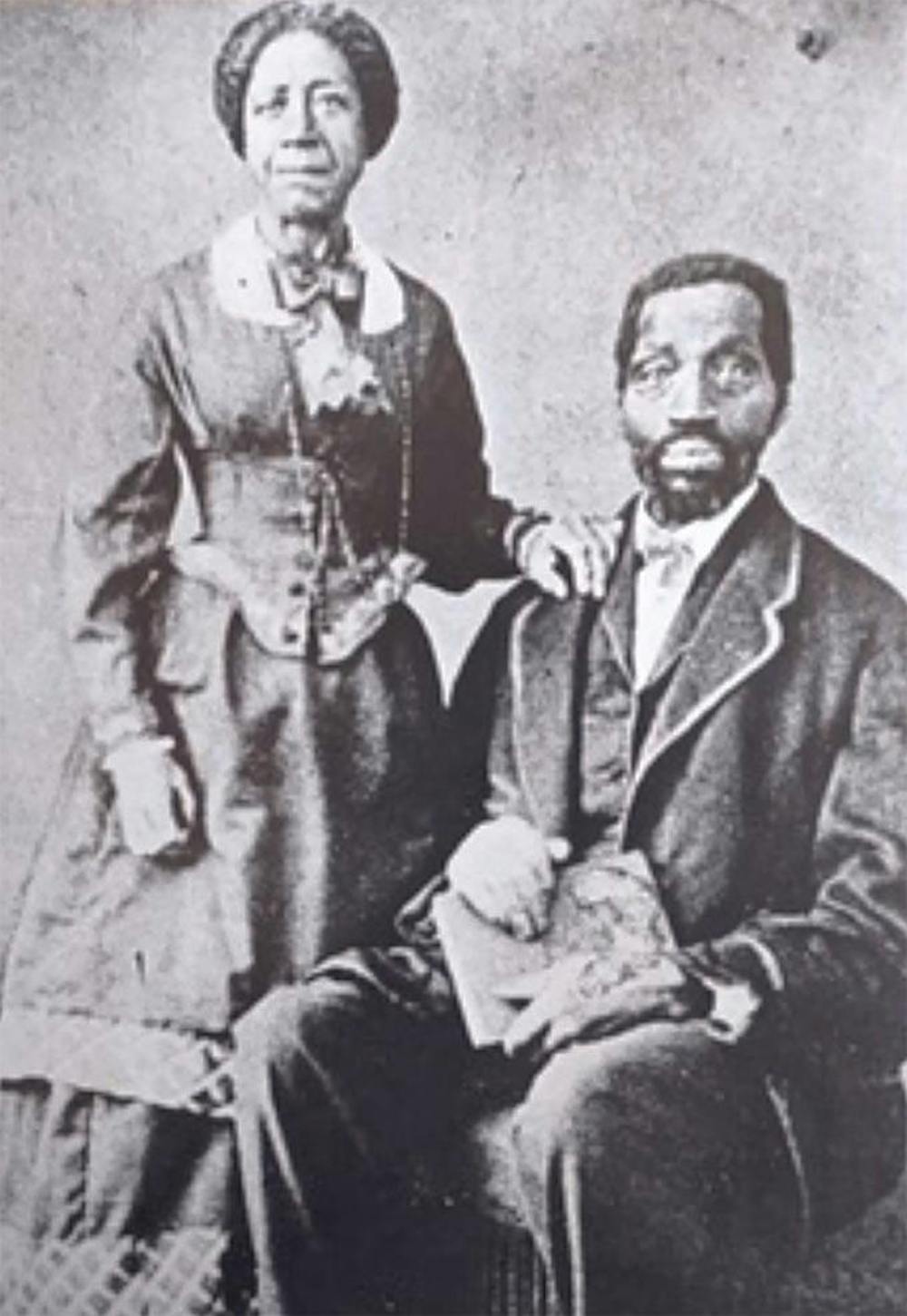
Abner Bennett’s story is one filled with many mysteries. When and where was he born? Was he a runaway slave or not?
According to the Michigan, U.S. Death Records, when Abner died in White River Township Sept. 3, 1879 from a hemorrhage of the bladder, it indicated that he was born in New York. On his gravestone, which is in Oak Grove Cemetery, it indicates that he was 80 years, 2 months, and 12 days at the time of his death. That would mean that Abner was born June 22, 1799.
His obituary stated he had lived in the area for 31 years, indicating he came to this area around 1848.
The 1850 U.S. Census shows Abner Bennett, age 51, Anna, age 30, and George, age 16, living in Oceana County. All of the individuals were born in New York. Was George the son of Abner and Anna? There does not appear to be any additional information about George after 1850.
Fragmented evidence indicates that in White River Township and Oceana Township, ordinary citizens occasionally won elections to the lower level offices during the frontier area.
Citizens of White River Township sometimes recognized capable men from non-traditional backgrounds as is seen in the case of Abner Bennett.
Abner Bennett, an African-American farmer and lay preacher, served as White River Township Treasurer in 1856. His election is a bit of a mystery, however, in as much as blacks were not even legally permitted to vote in Michigan at the time.
Some records indicate Abner was given his freedom by James K. Polk and some money which he used to purchase some local farmland and also start the first Methodist Episcopal Church in the White Lake area.
While James K. Polk was a slave owner, and even secretly purchased more during his presidency, there is no record of any enslaved individual named Abner Bennett associated with him. Polk’s Last Will and Testament expressed a desire to free his slaves, but not immediately. President Polk’s will stipulated that his slaves should be freed after his and his wife’s death, not during his lifetime. Polk died 15 Jun 1849. His wife Sarah Childress died Aug. 14,1891.
Abner and his wife Mary are credited with starting the first Sabbath school at the Mouth, which was held for 15 years at their home located north of the Old Channel in White River Township. Their house was also reported to be part of the Underground Railroad which led runaway slaves to freedom to Canada.
As members of the Methodist Episcopal church, the Bennetts were credited with helping to start a number of churches in West Michigan. It is reported that from 1854-55 the Bennetts walked 17 miles (almost six hours) south each Saturday from their White Lake farm to Muskegon to help lead Sunday worship and then walk back to their farm. They spread the gospel throughout the pioneer settlement of West Michigan and created the White Lake circuit in 1855, which included small congregations as far north as Little Point Sable, as far south as Muskegon and as far east as Newaygo.
Mary Bennett reportedly had been an extensive traveler in her younger days, having been a ladies’ maid for the wife of a Captain of a Merchant Trader on the Atlantic for five years, visiting all the European ports at the time.
It is also reported that she was a former servant of President James K. Polk. The term “servant” at that time, however, could have been either an enslaved person or a free laborer.
Sometime following Abner’s death, Mary must have moved into town from their home in White River Township. In the 1897 city directory, it showed that Mary Bennett was now living on Park Street.
Mary died in Montague April 11, 1899 from pneumonia at the age of 79 years. She was buried next to her husband in Oak Grove Cemetery.
On June 29, 1899, the following item appeared in the Montague Observer under the heading “Auction Sale:"
"By bequest of the late Mary Bennett the trustees of the M. E. Church of Montague became possessed of the personal property of the deceased, with power to sell, and accordingly will offer for sale to the highest bidder said personality, at the M. E. parsonage, on Saturday, July 1, 1899, commencing at one p.m. sharp. Following is a list of the articles for sale: 2 heating stoves; 1 gasoline stove; and furniture consisting of bureau, bedsteads, stands, chairs, centre table, dining table, whatnot, 2 clocks, pictures and picture frames, crockery and dishes in large and beautiful varieties, 3 rag carpets, feather beds and pillows, blankets, quilts, sheets and comforters almost without number, and an extensive variety of ladies’ clothing, clean and in good condition. Silver knives and forks and cooking utensils. Library books, consisting of a large number of standard books secular, historical and religious. Several medical works and instruments of value. Bric-a-brac, vases, bronzed statuary, oddities, and keepsakes in large variety, and of considerable value to those having a kindly remembrance of the sturdy pioneer."
The Auction Sale held Saturday, July 1, 1899, of the household effects of the late Mary Bennett was well attended. Auctioneer W. E. Osmun was very successful in disposing of the goods. Over $50 was realized from the sale, according to a news item in the paper that appeared July 6, 1899.
On Sept. 14, 1899, it was reported that William Barr purchased the property of “Auntie Bennett” on North Hill, of the trustees of the M. E. Church. No dollar amount was given.
In 1980, the Bennetts’ house in White River Township was still standing and there was some discussion about a future official historical marker being acquired. Unfortunately, the marker never materialized, and the house has since been torn down after many years of neglect.