I heard absence makes the heart grow fonder, so I hope readers can forgive my prolonged absence from The 1306 while I attended the usual May retinue of weddings and showers and babysitting gigs. But I think what may make readers feel fondest is shutting up and jumping right back into Camp Houk. Like one of my favorite authors, J. R. R. Tolkien, I come bearing an (only slightly bloody) appendix that may or may not be just as long as the original content. This week, I’ll be covering the origin story of the reunion grounds, as well as showing off some fun discoveries I made in the archive boxes at the Oceana County Historical & Genealogical Society.
So for starters - who was the Houk in Camp Houk?
Theodore G. Houk was a Civil War veteran who enlisted in the Michigan Volunteer Infantry and served as an officer in the newly formed Oceana County Veterans’ Association (OVMA) in 1880. With Houk at the helm, his Elbridge Township tract of land was selected and later bought for the purposes of serving as the reunion encampment. His significance to the county goes beyond just his founding role, as Houk is included in the oft-referenced “Oceana County Pioneers and Business Men of To-day.” Other contributions from the veteran include serving as supervisor for Elbridge, then later as state legislator serving two terms in 1884 and 1886, incorporating Hart and Shelby as villages, and donating land for a school attended by both white and Native children.
Great! Now that we know who Houk is, let's learn about the GAR.
Well, the Grand Army of the Republic, or GAR, was an official organization formed across the nation to provide mutual welfare, support and camaraderie to veteran Union soldiers. Now, the GAR did not yet have a chapter in Oceana County when Camp Houk began, and it would only be in the late 1880s that their significance was so that the organization could sponsor the event. Thus, it was widely recognized that, despite not beginning as such, Camp Houk was a GAR affair.
The GAR disbanded on Aug. 2, 1956, with the death of the final veteran in the organization, Albert Woolson. Such was the same end to Camp Houk several decades earlier, as there were no more veterans to attend the reunion.
Now for a graceless transition to some neat stuff I found at the Munger
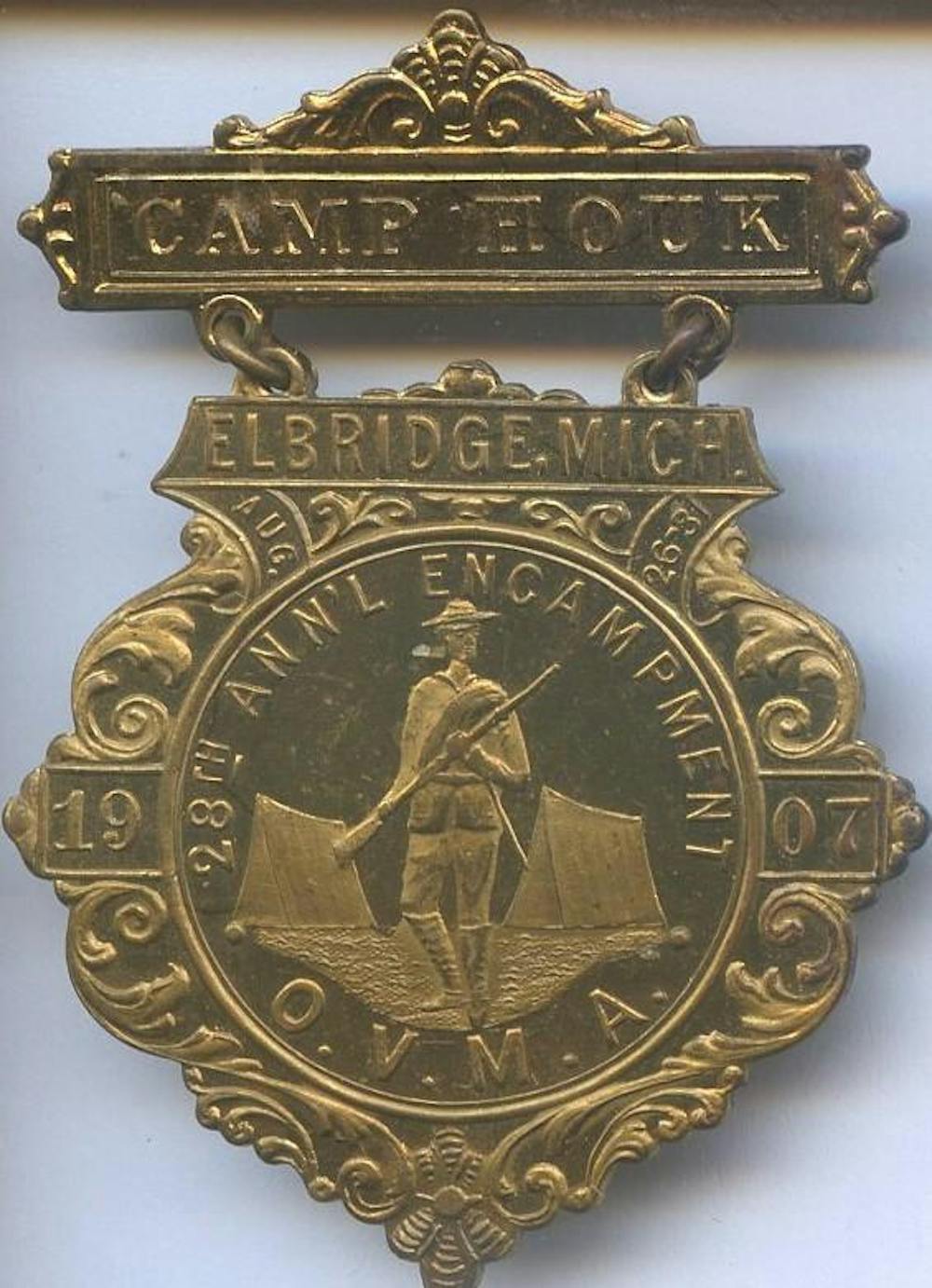
Figures 1, 2 and 3 are some medals from several different years of the encampment, specifically 1906, 1907 and 1909. The oldest two, commemorating the 27th and 28th annual encampments, note the August dates and the organization (still notably the OVMA despite the GAR’s involvement). Particularly of note, the 1906 pin is embossed with a depiction of Hart’s GAR Veteran’s Monument, erected in 1904 outside the county courthouse.
The 1909 design is a notable departure, as it's a colorful celluloid pinback button. This took me aback, as I did not know campaign-style buttons could be this old. But, in fact, they were first patented in 1896 and started to become widely accessible about a decade later, explaining the fun new Camp Houk button design.
Many of these pins would have been affixed to commemorative ribbons, such as shown in Figure 4. This ribbon was designed for the 11th annual encampment in 1890, and also includes a start date of Sept. 20 for the event - a whole month later than expected.
Figures 5 and 6 are paper tickets, “Good for one dance,” at Camp Houk’s bowery. They date to 1916 and 1917, respectively, and also note the proprietors of the dance. In the archival box, these tickets were just one of dozens I found in a plastic Ziploc bag, which I can only imagine is the same amount of tickets I’d force my poor date to purchase for us should I ever travel back in time and attend Camp.
Finally, Figure 7 is the cover of a complete collection of “Army Ballads, Favorites of the Brave Boys Who Wore the Blue,” made for the fourth annual event in 1883. Mind you, while it's the fourth reunion, it would be the second held at Camp Houk, making this find certainly the oldest in the box. At the top of the cover, a Pearl Peacock signed her name so that such an invaluable collection would be returned to her if lost.
Best believe I searched through the booklet to see if there were any rowdy songs that the soldiers reserved for late-night crooning around a fire after a couple of drinks. However, the boys in blue kept it PG. Devastatingly, many of the songs were about how much they missed their mothers, bookended between two different versions of The Battle Hymn of the Republic (“Glory, Glory, Hallelujah”).
For our final Camp Houk installment next week, we’ll be taking a look at the future of the property and how it might serve as a historical landmark for the community to visit.