I took a friend to the cemetery this past weekend. I promise he chose the outing himself. I don’t kidnap acquaintances and tour them around graveyards. However, he did give me an inch, and I, in turn, took several miles, planning a whole afternoon with a round-trip loop through three cemeteries in southwest Oceana County.
It was a perfect day - sunny, upper 60s and a refreshing breeze coming off the lake. We started up a dirt country road that led us to the quaint church of St. John the Baptist Catholic Chapel in Claybanks Township. It is the quintessential old-fashioned American church, stark white, with a cupola-style steeple and belfry, all perched on a hill overlooking rolling fields and farmland. There was even a horse grazing nearby!
The cemetery adjoining St. John the Baptist climbs up the same hill, with rows of pearly white marble and ruddy granite, shaded by enough trees to offer shelter but not so many as to be overgrown (I take the tree-to-land ratio at cemeteries very seriously). We parked our car and started at the top of the hill, meandering through what were clearly the most recent burial plots.
I’ve spoken about historic headstone “trends” before, but I’d also like the record to reflect that I enjoy trendspotting newer headstones just as much. A design we noticed that was repeated over and over again through this particular cemetery were etchings illustrating photo-realistic landscapes and homes. My friend and I spent several minutes speculating what the locations must represent and how the illustrations were made when we heard a car roll its way up the gravel path.
In that car was the one person who could answer all our questions. If there is a single living person who knows that churchyard inside and out, it’s Joanne Kessler. We’re acquainted from many shared hours at OCH&GS, with her and Karen Urick pouring over census records and findagrave.com, connecting family trees like detectives. I hope they don’t mind me saying this, but they’re some of the few people whose conversations are so entertaining to listen in on that I rarely have my headphones in while I work anymore.
Joanne and I exchange pleasantries, and, immediately, I am dropping hints about how she should absolutely take us on a tour of the grounds and the church - which she was more than happy to oblige. First, she shows us her parents' stone, one with an illustration of a beautiful farmhouse and barn, their home. She pointed out another of the engraved headstones (“that’s their cottage”) and another (“and that’s the view from their cottage looking over Lake Michigan”).
Joanne even points out her own future plot, already planned out next to her parents. Perhaps a little morbid, but that’s cemetery people for you. “You know,” Joanne said, “I always meet the most interesting people in cemeteries!”
St. John the Baptist Chapel is well over 150 years old, and the cemetery is just as old. In fact, Joanne’s family, the Mills, gifted the land to the church for the use of burying the congregation at their beloved meeting place. The oldest plots are at the bottom of the hill, and Joanne points out the spot where the church terraced the hill to make room for the “new” section of the cemetery.
Along the way Joanne points out the large families interred together, the Civil War veterans, WWII nurses and the young man who died training for the frontline in WWI. Joanne explained how the genealogy bug bit her after her mother shared that “back in the day, people didn’t go too far from home, so most of them ended up married to their neighbors,” a claim which she obviously had to research and verify. Turns out, the small-town adage of “everyone knows everyone” could’ve very well been coined here.
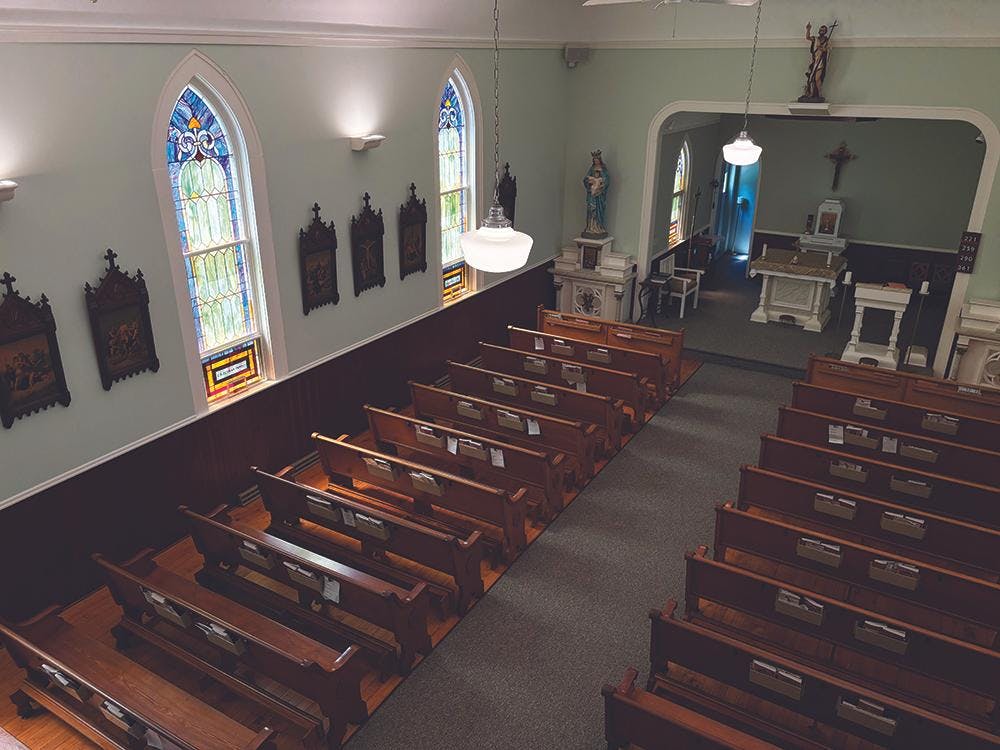
What’s more, the familial connections aren't just relegated to the cemetery, as Joanne explained, leading us down to the basement door she had the keys to open. There are eight stained glass windows and two altars, which were sponsored by and bear the names of parish families. The windows were purchased and installed in 1917, and they’re (pardon the pun) heavenly - geometric panels of spring green, interconnected with delicate diamonds, and framed by a rich blue-violet border. The bottom panels - about the size of a very ambitious breadbox - display a family name and can be propped open for airflow (beauty and function!).
On the windows you’ll find family names such as Schiller, Deyman, Miller, Eilers, Kelly and Rager. The altars were sponsored by Christopher and Margaret Rager and Frank and Agnes Sowinski. A stained glass window was also installed over the front entrance of the church, sponsored by the Altar Society, at the same time as the rest of the windows, but was removed in 1964 when an addition was made to the front of the church. It was finally reinstalled back in the early 2000s during the last major renovation of the church.
Joanne also pointed out the complete set of antique Victorian paintings depicting the 14 Stations of the Cross, encased in stunning wood-carved frames. According to our tour guide, when a couple of the paintings were taken to the Detroit Institute of Art for repairs, the experts told them the fact that they had a complete cycle with all the original paintings was extraordinarily rare.
But more precious than all the artwork inside the church (figuratively speaking) are the memories Joanne shared with us of her family, her neighbors and the love poured into that building. As we parted ways, Joanne got started with the work she’d originally come to do, planting flowers. Fixing her gardening hat onto her head, Joanne thanked us, “for letting me talk about the place I love most in the world.” And from the top of that quiet hill in the middle of Claybanks, I couldn’t imagine loving a place more.