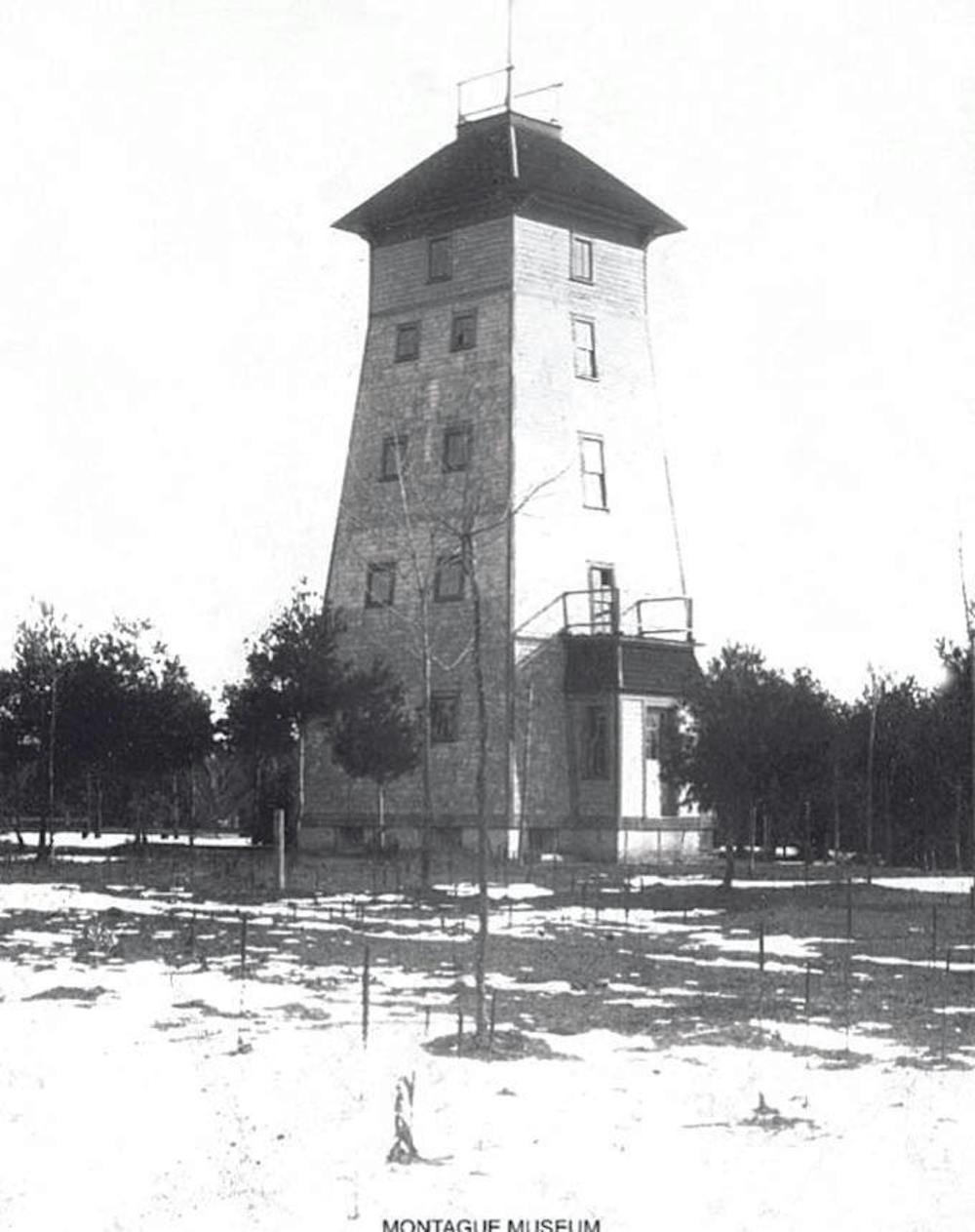
During the year 1875, the residents of Montague witnessed the construction of a mysterious tower by DeWitt Clinton Bowen. Initially people were uncertain regarding the purpose of the tower but as time went on it became clear that it was constructed as a water tower. The Aug. 5, 1875 issue of the Whitehall Forum attempted to amuse its readers with the following:
“A tower, forty-eight feet in height is being erected near the base just below the Presbyterian church, the use of which our reporter has been unable to ascertain. Some have said it was intended for a jail; others that in it the Lumberman editor will be hanged by the neck until he is dead—dead; and still others that it is a water tank to supply the residence of D. C. Bowen with water. Alas! We do not know.”
Near the base of the tower was a clear spring that was used as the water source to fill this tower. A hydraulic ram pump was installed which pumped the water to the elevated water tank. A pipe system was installed and gravity provided pressurized water for the Bowen household.
The Sanborn Fire Insurance map from Montague dated December 1883 notes the tower location and the height to be 40 feet, and located just off Prospect Street, which is now known as Old Channel Trail. Today the location would best be described as approximately 300 feet southwest of the intersection of Knudsen Street and Old Channel Trail, and then approximately 80 feet southeast of the base of the bluff.
In 1891 George Dowling acquired the tower and moved it to his Buttermilk Springs Park. It is probable that the tower was dismantled and transported piece by piece to the park for reconstruction. On Oct. 9, 1891, a number of people from Montague and Whitehall found themselves at the park by special invitation. These individuals assisted in the erection of the tower framework in which will be placed a large tank, at a sufficient elevation to force water to town. (The Montague Observer, Oct. 15, 1891)
The Oct. 1, 1891 issue of the Whitehall Forum mentioned that a crew was busy working at the park constructing a steam water system for the entire grounds. It is probable that the water tower was to play an important role in this system.
The Oct. 15, 1891 issue of the Whitehall Forum commented that a hydraulic engine using the water head from a pond created at the park by George Dowling would be used to fill the water tank which would then power fountains and springs in the park. It was believed that he would also run pipes from the tower to his residence to provide pressurized water.
George Dowling was not prone to divulging the intentions he had for the park therefore many people had to speculate what his ultimate goal was for the property.
Many believed that he was eventually going to gift the park to the city for all to use. Ironically, many people were already using the park for their pleasure, and this frustrated George to the point that he placed a sign at the entrance that read “Stay out of these grounds.” George had lost patience with people pulling up his stakes, and generally interfering with this work of beautifying the place. (Whitehall Forum May 15, 1890)
The tower was placed at a spot on the property that provided a view down the length of Buttermilk Creek, past the Franklin House, all the way to the former Ferry Dowling & Co. sawmill.
It is unknown if the tower became functional as designed since George Dowling died March 30, 1896. The grounds suffered from neglect until the property was sold in 1906 to H. C. Leichsenring who hailed from Chicago, Illinois. Mr. Leichsenring and his family actually resided in the tower until construction of their house was completed. They had been summer residents since 1903. The tower eventually succumbed to the effects of time, weather and environment and was torn down.
Herman Carl Leichsenring was born in Dresden, Germany Jan. 8 , 1865. He came to Chicago in 1887. He married Minna Lietritz Aug. 1, 1887 in Chicago. They had four daughters: Johanna (1890-1975); Ann (1894-1985); Elizabeth (1895-1982); and Gertrude (1900-1991)
He and several others organized the Art Marble Company of which he was General Manager and Director for 30 years. He retired in 1920. After a couple of years of peace and quiet he returned to an active business life and became President of the Mid-City Marble Company.
Herman died at Hackley Hospital in Muskegon Nov. 15, 1926. His wife died at daughter Gertrude’s home in Montague March 7, 1952. They are both buried in Oak Grove Cemetery along with two of their daughters.