Vernacular architecture can be defined as a classification of this practical art made by craftsmen with materials local to a geographical area and techniques honed over decades, centuries, or even millennia. Simply put, its architecture for the people and by the people. In the U.S., it looks like the shotgun houses of the American South, adobe homes of the Southwest, and the log cabins that marked the way of westward expansion - as old as Native American wigwams or as recent as great grandma’s lake cottage built by the family.
Historic homes, especially in Michigan, usually fall into two categories: houses made by master architects (think the great lumber baron mansions designed by foreign architects) or those of vernacular architecture.
Last week’s building, the Hart Post Office, was built during the Great Depression and designed by federal architect Louis Simon, falling into the first of those categories. This week’s building, the Chadwick-Munger House, I would argue falls into the latter category, that of vernacular architecture. It’s not a farmhouse built by a European immigrant with Scandinavian techniques and local materials — rather, it is a great stone house that looks more similar to a castle, or maybe the setting of a Scooby-Doo episode.
But from what I can tell, this was a locally made home constructed by homegrown folks with some bricks and a dream. My information for this week primarily comes from a book made for the Oceana County Historical & Genealogical Society to commemorate their 1985 acquisition of the home to house their genealogical research material and collections. “Chadwick-Munger, The Story of a House,” by Kathleen Longcore, granddaughter of the home’s original builder and owner, Harvey Chadwick, recounts the construction and primary owners of the Dryden Street house.
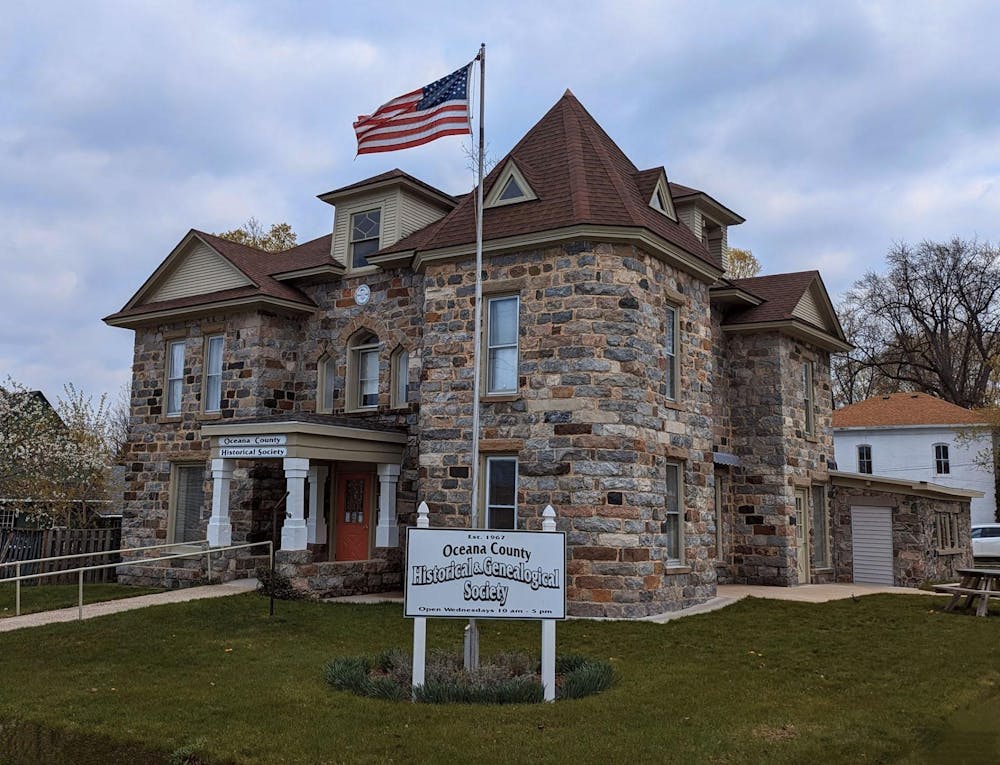
The house is located just behind the courthouse, an austere, brown and grey-brick building with three floors and a turret on the southwest corner that looks rather like a castle tower. A Grecian-inspired portico with white columns heralds the front door, with two alternative entrances on the south and east sides.
The style is reminiscent of Victorian architecture, as per the style of the day, when it was built in 1892. For the specificity of what flavor of Victorian architecture, I asked my best friend and architectural historian, Clara Miller, who thinks “it’s remarkably ambiguous. I’d say Romanesque Revival (minus those windows over the entrance) is my closest bet, but they were just doing whatever they wanted here.”
To which I said, "Oh yeah, I totally see that,” as if I had studied any architecture past 1500 B.C. But the elements are there: stonework, turrets, general castle vibes. But as Miller said, it’s a choose-your-own-adventure of whatever looked neat.
Construction on the home started in the late 1880s by Harvey Chadwick, a local Hartian man who received his medical degree at Detroit Medical College before returning to his hometown to practice medicine. The house was constructed over several years when Chadwick had the time and money.
The bricks, perhaps the most distinctive feature of the exterior, were laid by George Dennison, Hart’s “foremost plasterer, bricklayer and stonemason at that time.” This material was, according to Chadwick, locally sourced, which supports the definition of vernacular architecture.
Now, these “bricks” are not clay, but rather stone cut into brick shapes. Brick buildings aren’t uncommon in West Michigan, and, in fact, many brick buildings were made with scavenged bricks used as ship ballast. Stone, however, is a lot less common of a material and expensive too. What’s more, most stone buildings in West Michigan are either kept in their original shapes (many cobble or scavenged field stones), rough hewn or circularly cut. It certainly makes for a distinctive landmark in downtown.
When primary construction finished on the house in 1892, it was two stories, with a hopeful staircase leading to a future third floor. The portico entrance was for the family space, opening to a music room on the right and a parlor on the left, with an adjacent dining room and kitchen. Beyond the music room was Dr. Chadwick’s office, with the south entrance for the sick and injured public. Perhaps the most striking interior feature was the grand staircase, located just across the front door, with a landing that bisected into a T shape. Around the spacious foyer was a gallery railing, the joy of daredevil children everywhere, so the anecdotes say.
This is how the Chadwick home looked for the first several years of its existence. Sadly, the Chadwick family only spent two years in their dream home before the doctor made the difficult decision to move to the more financially viable city of Grand Rapids in 1895.
From there, it was rented out by the new doctor in town, Louis Phelps Munger, along with his wife, Edith, and their young son, Robert.
Next week, we’ll go over the changes made to the home by the Mungers and the ownership saga of the historic building after its use as a family residence. If you’d like to share any stories about the Chadwick-Munger house before the OCH&GS moved in, feel free to contact us and share!