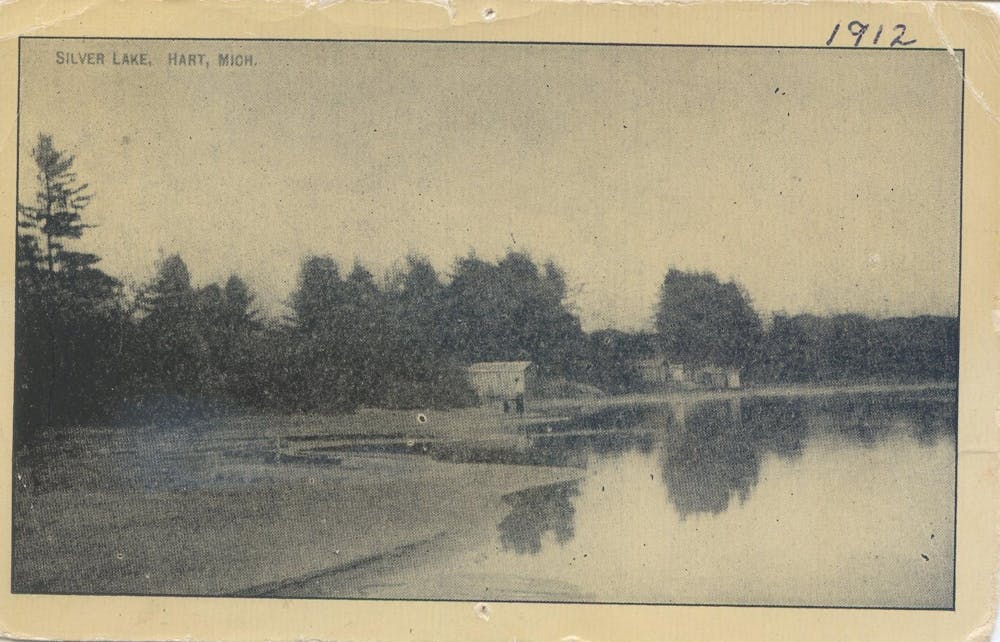
Our final postcard for the month of February shows Silver Lake in the early 1910s, a black and white picture of a set of cabins perched on the sandy shore of mirror-like Silver Creek. Behind the rustic-built cabins is a line of pine trees, their reflections stark in the still water. Along the water’s edge walk two figures, one small and the other tall - a child and parent, perhaps?
The message on the opposite side, written on the vertical of the card, has absolutely nothing to do with the photograph on the front of the card. I am finding this more and more common, particularly in correspondence between local Oceana County residents (this card was postmarked in Hart and sent to Mears).
The more I think about it, the more it makes sense - postcards were not always used as a vacation souvenir. Many times they were utilized to send a quick and cheap message a short distance away. Often the messages will concern a quick question, wish a sick family member well, or promise a longer letter is soon to come - for younger generations, think of the difference between a text reminding your sister to pick up shampoo at the store versus an email to your long-distance friend updating them on your last few months.
Such is the same for the message here, sent on April 8, 1912, to Miss Grace Lind of Mears.
“Hello Grace
Well are you people going to the dance at Crystal Friday night April 12. Did you see any strangers at church Sunday night[?] Please let me know about going to Crystal in plenty of time.
Eva Skeen”
This message perfectly exemplifies a simple question or statement only relevant for a short period of time. In this case, Eva wanting to know in the next four days whether Grace will be attending the dance in Crystal Valley. This message also goes to show that young adults have always based their attendance at social functions on whether or not their friends will be there, because nothing is worse than having to socialize at a social function.
While transcribing this postcard, I couldn’t help but think that I’d read this message before, or at least, I knew the name Grace Lind. Turns out, in July I transcribed a postcard sent six years prior to her sister, Clara Lind, in Chicago, so I was already familiar with her family, well-respected business owners in Mears. As with the postcard sent to Grace, Clara’s postcard was also another quick message scribbled on the back of a card picked at random.
As for the subject of Grace’s card, I can relate to making sure your friend will be at a party before you go, but the event in question - a social dance - is a concept I am a couple generations removed from. A social dance is, put simply, a dance with a communal aspect rather than a performative one. The dancers are not professionally trained, and the event is more a vehicle for interaction than performance art. Think swing dancing in the mid-20th century, the balls in Jane Austen’s novels, or line dancing. One aspect of social dances was that they were enjoyed by people of all classes, from aristocratic ballrooms to peasant country dances on holidays.
In the OCH&GS archives, I actually managed to find an invitation to a local “Social Dance and Oyster Supper.” It cordially invites “Yourself and Ladies” to attend the seafood supper and social “hop” at the Chamberlain’s Hall in Ferry on November 26, 1885, in celebration of Thanksgiving Day. The invitation also promises “good music in attendance and a good time for all,” with an admittance fee of $1.50 per couple, including dinner, which would be about $50 today. I can’t judge whether that’s a fair price for a social dance, as the closest comparison I have is my senior prom, and I can’t remember the ticket cost since I made my date pay for both of us. However, $50 for an oyster supper for two sounds like a steal!
Towards the end of the 19th century, social dances were becoming less and less focused on etiquette as they were in Jane Austen’s Regency Era, but still kept many of the common European dances of generations prior, such as waltzes, polkas, gavottes and quadrilles. If you want to spend an afternoon getting sucked into the history of social dances, the Library of Congress and Archive.org have a wealth of old, scanned copies of Victorian manuals dedicated to instructing hosts and attendees.
By the time of Grace Lind and Eva Skeen’s dance in 1916, waltzes and polkas were still in fashion, but the two-step was becoming increasingly more popular, as were “naughty” dances like the “turkey-trot” and the Argentinian tango, worse yet, accompanied by ragtime music. I can’t say how likely these oft-moralized dances and music (notably influenced and popularized by Black and Latin artists) would have been a century ago in Ferry, but it’s not outside the realm of possibility that a dance with young people would feature popular "young-people-music."
So what have we learned? Regardless of whether your social dancing includes the turkey-trot or the cha-cha slide, your parents will probably hate your music, and you’ll be frantically asking your friends if they’re coming to the dance because “I’m not going if you’re not going!”