The following article appeared in The Whitehall Forum on Thursday, Feb. 16, 1888 and was submitted by volunteer contributor Barbara Bedau Brow.
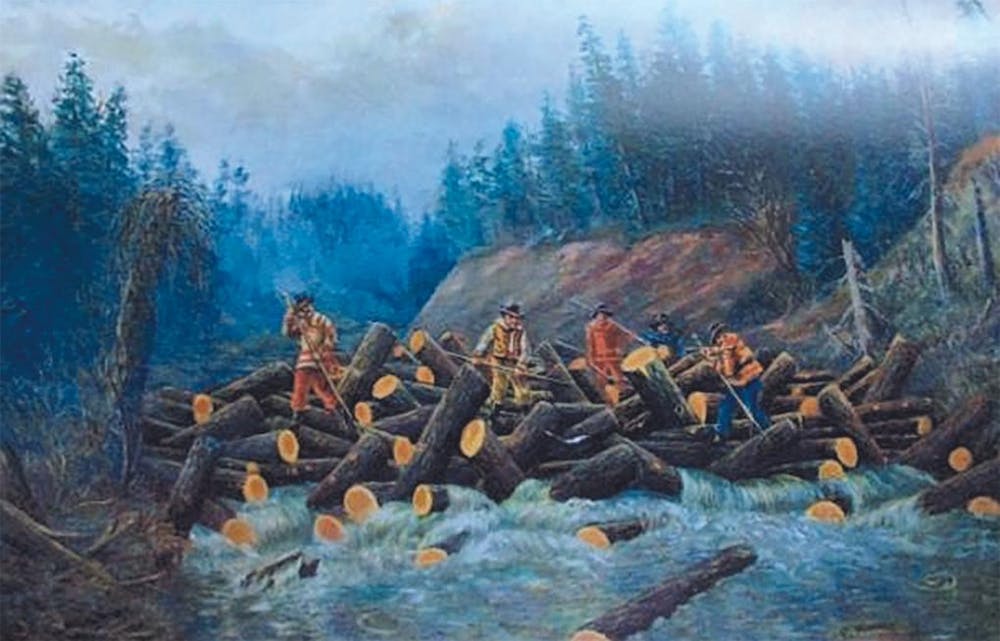
A lumberman gives the following realistic account of a scene that is familiar on the White and other rivers where lumber operations are conducted. To those who have never seen the breaking of a rollway, the description conveys as vivid a conception of it as words can portray:
The most exciting and dangerous period of the lumberman’s always perilous life in the woods is now approaching – that is, the “breaking in” of the log piles heaped or ranked at the summits and on the faces of the long rollways that border the streams in the lumber woods. These rollways extend from the tops of high and abrupt banks to the water’s edge.
There are two ways of piling the logs at the rollways – one by laying them in regular ranks or tiers, and the other by throwing or dropping them in jumbled heaps on the ground. In the latter method the logs lock, cross and key one another, and so it frequently occurs that some logs in a dangerous position must be loosened at the risk of life and limb before the logs have gone down the steep hillsides to their place in the water. This style of piling logs is called a rough-and-tumble. Many fatalities attend it every year, while the square and regular piles are manipulated with comparatively little danger and with tenfold greater facility.
In the regular piles, tier on tier, the logs are started in a body down the rollway, and they usually go down in one great heap clear into the water. In the other way, the logs are dumped from the trails and lie in a ragged, promiscuous jumble from top to bottom of the rollway. The key log or logs may be at the bottom of the pile, in the water, or halfway up the hill. There are always such configurations of the pile that there are many openings like great pitfalls here and there. At some of these piles the rollways are selected at places in the creek where the banks are high on either side. Then high dams are thrown across below, with floodgates. By these dams the water can be thrown back, and by manipulation of the gates raised and lowered among the tightly massed logs so that it lifts them and generally releases the jam.
But even where these dams are in use, there are frequently piles so obstinate that nothing but the skillful work of the lumberman on the key logs will break them down. These logs are often woven together almost like a web, and to the inexperienced spectator the task of unravelling it, as it may well be called, seems beyond human power. But there never yet was a log pile so tightly eyed that the agile and expert log driver could not break down, although he may not only risk but lose his life in doing it. It seems utterly incredible that men could be found so daring as to make their way out along these ley, jagged and twisted piles, with two thousand waiting logs above them, held probably by the obstinate keying of a single log, and ready to thunder down upon them the instant that log is moved a half-inch from its position. But the occasion is only needed to produce such men by the score, no matter how great the danger may be.
The woodsman makes his way nimbly but with caution over the protruding logs and across treacherous pitfalls, frequently disappearing entirely beneath some lifted group of immense timbers, as he tries to locate the log or logs that prevents the great pile from breaking and completing its lightning like plunge into the stream below. The log that makes all the trouble may be near the bottom, which, of course, increases the peril. The woodsman’s quick eye is not long in demonstrating how the key may be most advantageously removed, and he at once proceeds to accomplish his task. One or two blows of his axe may be sufficient to remove an obstruction that has defied the many tons of pressure from above. It may require an hour’s chopping and prying, and it may take a day’s hard work to break the jam.
When the key is broken, however, is the time when the driver must use all of his nimbleness, nerve, and skill to escape from the rush of pitching, tossing, and thundering logs that he has started. He leaps here and there, and jumps from log to log in his flight, with the avalanche of timber pressing close behind him. The fatalities that accompanies the “breaking in” of log piles in the lumber regions would startle the public if made a special item in reports of vital statistics.
The rush of a pile of logs down a steep rollway, unobstructed, is as exciting a scene in itself as anyone could wish to see. A hundred logs, rolling, tumbling and roaring into a stream will dash the water fifty feet in the air, and leave the bottom of the stream as bare as the shore until the water falls back, again in foam and spray.