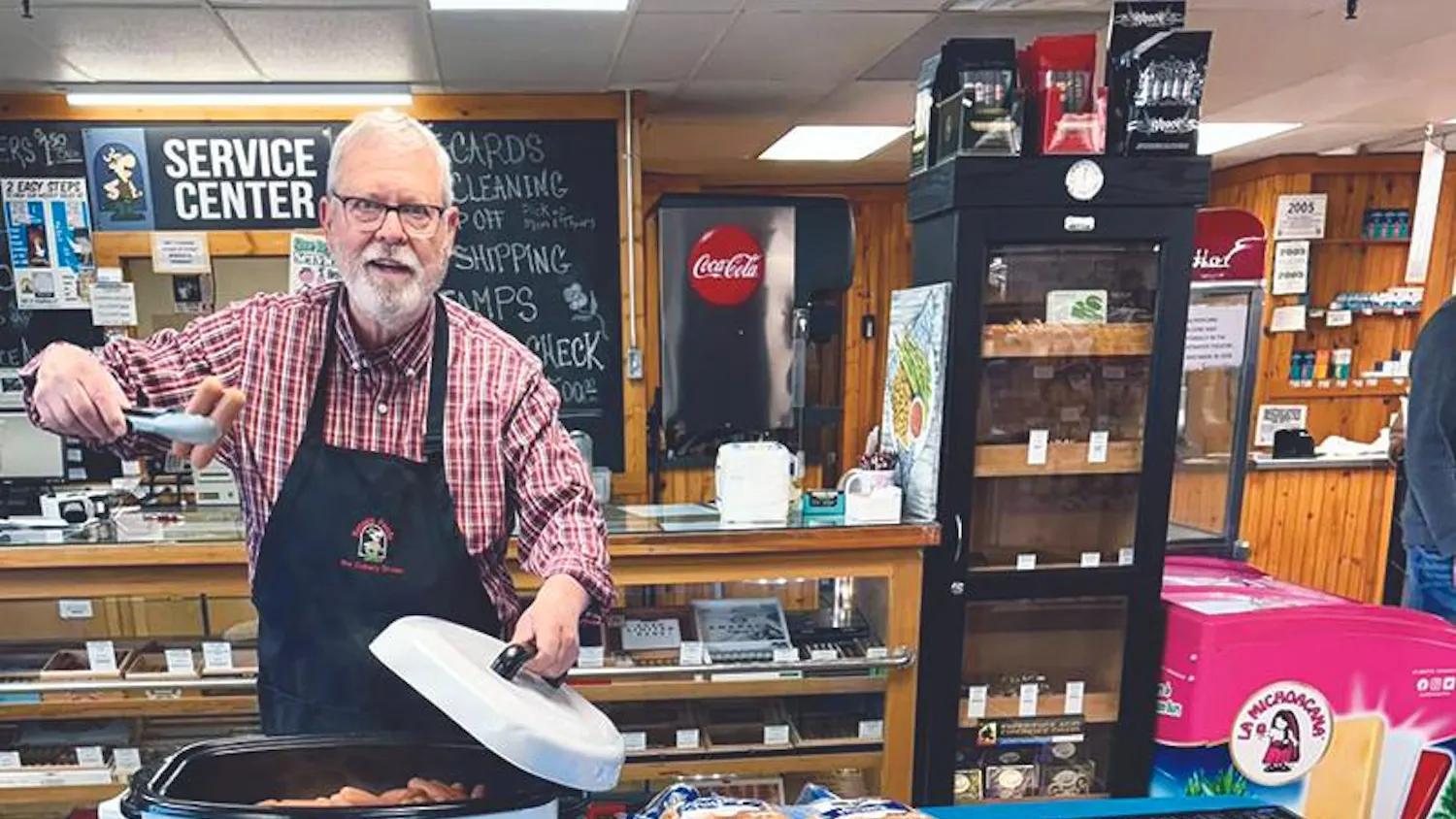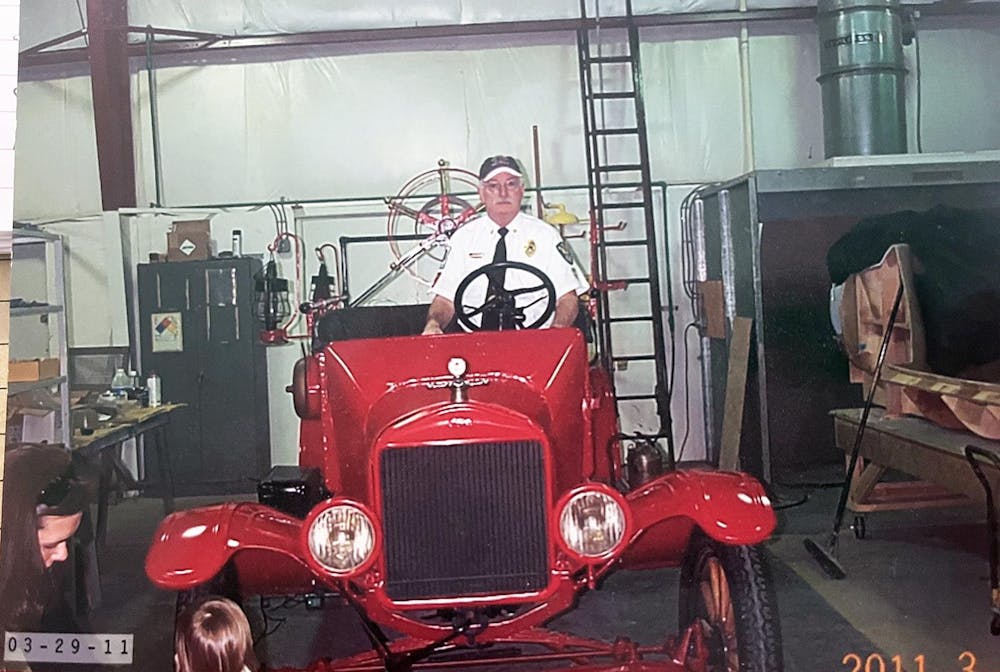
At its November meeting the Pentwater Township Board signed a Proclamation honoring former Fire Chief Terry Cluchey for 40 years of service in the Pentwater Township Fire Department.
The Proclamation drew attention to Cluchey’s “unwavering commitment and professionalism…his selfless service, often placing his own safety at risk for the welfare of others…his being highly effective as a first responder but also a dedicated mentor and leader…upholding the highest standards….”
Cluchey officially retired from active duty on Nov. 1, 2025, with respect from his peers and the greater community. The board offered appreciation on behalf of the township’s citizens and extended “best wishes for a long, healthy and joyous retirement.”
Cluchey joined the Pentwater Fire Department in 1985. “I joined out of a sense of civic duty, but there was also a social aspect because many of my friends were firefighters. It was fun at the time to ride to a fire, hanging off the back end of the truck. The camaraderie in the firehouse afterwards was rich.”
Back then the fire trucks had small cabs to seat only two firefighters. Cluchey said the trucks today have space for up to six firefighters in the cab, and everyone is required to be in a seatbelt for safety’s sake.
Over the years, Cluchey has served in a variety of ways. He was fire chief from 2000-2018 after having been the secretary. He spent many years as head of the medical “first responders” team, and he was the treasurer the last four years of his service. He noted several changes he has seen during his service. “The secretary used to take meeting notes by hand. Now all meeting notes need to be sent by computer to the state for their records. Training for firefighters has become much more complex and every firefighter needs to go through an audit to ensure he/she has updated skills and information.”
He continued, “In my early years we responded to 30-40 calls for fires a year and 6-12 calls for medical help. But since then, the Pentwater and Hart fire departments made a mutual agreement to both respond to any call in Oceana County. Occasionally they even respond to calls in Mason County. That has brought our recent year totals to 400 calls for fire and medical combined.”
Being a lifelong resident of Pentwater means that Cluchey frequently knew the people to whose home he was summoned for fires or medical help. What calls did he find most difficult? ”Hands down the hardest calls were any that involved a fatality. I remember a structural fire in a house that had only one door for entering and exiting. An elderly resident died because the fire blocked her way to the one door. That was disturbing because a second door might have saved her life. I also found medical calls for infants very challenging.”
Not too many years ago the fire department had its own ambulance parked at the firehouse. But the administrative work for running an ambulance service was a real headache, and it was very expensive to maintain. A decision was made to engage the services of a large ambulance company (Life EMS) that answers calls for multiple municipalities. Along with other voting districts, Pentwater Township voted for a millage to cover the cost.
Cluchey said he sees advantages to that, but also some complications. The medics are highly trained, and several units can be dispatched when large fires or accidents require it. But it can also mean a longer wait if an incident occurs when the units have been dispatched to a call that takes them a distance from the incident. The fire department is dependent on the service for transportation to a medical facility. This increases the responsibility of the fire department’s first responders.
Perhaps the largest local fire in the past 20 years that Cluchey and many readers can remember is the fire that destroyed the Nickerson Inn. Fortunately, no lives were lost. The biggest challenge in fighting that fire was the lack of water. “The water tower had been drained for routine maintenance, and we had to call for pumper trucks from other departments to pump water out of the lake to extinguish the fire.”
Cluchey was familiar with the history of the department long before he joined it. “The first engine owned by the department was a steam-powered engine called the Oceana. In 1922 it was replaced by the first motorized fire truck, a Model T, that was used until sometime in the 1950s. That truck still pumps water, and it is owned by a collector in Maryland. He found the truck’s ownership history and called me for further information about the vehicle. He sent me a current photo of it, and it looks very sharp yet.”
While many policies and guidelines have gotten tighter for the sake of safety, Cluchey mentioned one policy that has relaxed, and that is the residency requirement. Whereas the department once required all firefighters to live in the village of Pentwater, there is no such restriction today. Of the current department members, only two are residents of Pentwater. One of them is Aaron Boyko, who joined the department in 1999, the year before Cluchey was voted in as the new chief.
Boyko fondly recalls, “Terry has always been the guy who knew how every pumper, hose, valve (and) fire hydrant worked, along with a whole lot of other equipment too numerous to mention. The firehouse was and still is a place of great camaraderie between the young and the older firefighters…but Terry was and is ‘old school Pentwater’ with a history of tales and stories that would enlighten us on the past history of our fire years…and of Pentwater also. His presence reminds us of why we love giving back to our community. Terry was part of saving many lives that I remember since I’ve been on. Up at all hours of the day and night is not for everyone, but Terry made it look easy because he cared for everyone, and we never will forget his laugh and smile at the officers' table.”
When asked what he took most pride in over his four decades in the fire department, Cluchey replied he was grateful for the role he had in providing increased safety. He explained, “I’m referring to safety not only for the firefighters, but also for the residents involved in structural fires and the curious onlookers who could get too close or get in our way. Boundaries had to be marked and enforced. Firefighters had to learn how to avoid updrafts by mistakenly opening doors that fed oxygen to the fire and built its intensity. Hip boots and long rubber coats were replaced by safer, insulated clothing. Training became much tougher. Trucks today provide safer transportation for firefighters. All were much-needed improvements.”
Cluchey’s self-assessment was echoed in comments by Ray Hasil, another local now-retired firefighter. “As somebody that served under Terry in many capacities over the years, I would say that Terry was an agent of change that led Pentwater Fire Department into modern firefighting as we know it today through the adoption of safety, certification and training best practices. New members were required to complete firefighter certification. Under Terry’s years as fire chief, the membership grew smaller but was far better trained and equipped than ever before. A new Medical First Responder unit was started in 2006, and that unit responds to approximately 80% of the department’s calls today.”
Another quality Hasil appreciated about Cluchey was his lack of ego and willingness to support anyone’s suggestion that made sense. If Cluchey arrived on the scene after another department member arrived first and was doing well as the acting incident commander, Cluchey was happy to let that member continue and gain leadership experience. Hasil claimed Cluchey rarely missed a call and estimated he responded to about 5,000 calls in 40 years. “Whenever somebody in Pentwater needed help, there was a pretty good chance they would be seeing Terry Cluchey during the response.”
It's not surprising that Cluchey, now 81, asserts that what he will not miss about his years in the department is getting up in the middle of the night to answer a call. “The older I got, the harder it was to wake up and respond to emergencies.”
Asked if she ever worried about Terry’s safety in his long career fighting fires, his wife, Marilyn, replied, “Not really. The only time I felt concern was when he responded to a very large fire. Then I told him to be careful.”
During this interview, his phone rang. He looked at it and said, “There’s a medical call to the Oceana Care Facility. Someone fell and needs assistance.”
He smiled and said he had asked to be left on the line for calls. “I may not have to answer the calls, but I like to know what’s going on.”