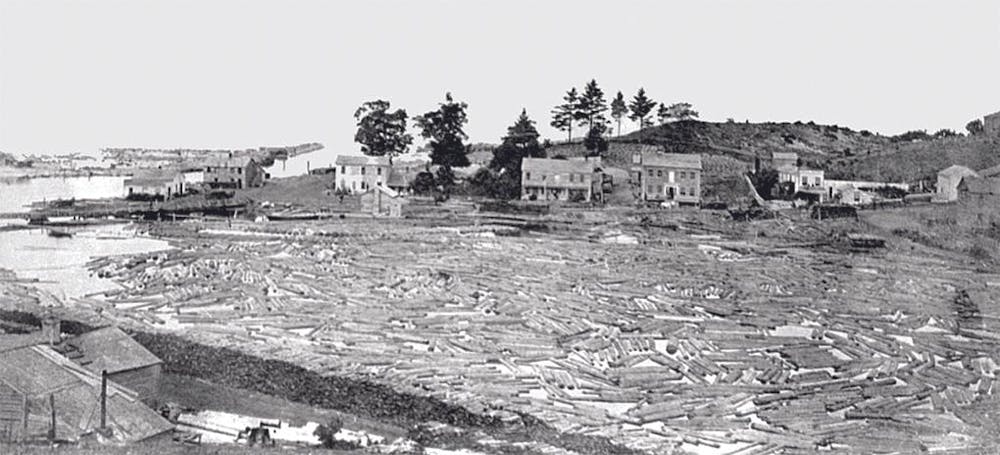
Construction of the existing man-made White Lake channel began in 1867 and was not completed until 1871. The light house was built in 1875. The United States Life Saving Station was built across the channel from the light house in 1887.
Prior to the creation of the channel in 1867, there was a natural channel that flowed from White Lake northwestward for about 3,550 feet and emptied into Lake Michigan in the area best described as near the present Old Channel Inn. A settlement was started in this area sometime in the late 1840s and flourished for nearly 40 years.
Through the years, the area was known by a variety of names such as “Stump” or “Stump Post Office”, “Ferrysville”, “White Haven”, and more familiarly as the “Mouth”. The first name, “Stump”, may allude to the fact that a hollow stump was used as a repository for the mail that was brought up the beach from Grand Haven. S. J. B. Watson acted as the Postmaster. In 1854 the government established a post office there, the first one on the lake, and they named it the White River Post Office, with A. A. Caine as Postmaster.
In 1850, the first steam mill was built by Rev. William M. Ferry of Grand Haven on the east side of the channel just south of the present cement bridge across the Old Channel. There was also a company store and several shanties where the mill workers lived. This small hamlet was known as “Ferrysville”.
On the west side of the channel was a small settlement which was inhabited mostly by a company of Irish fishermen and some coppers who made barrels for packing the fish they caught. This settlement was known as “White Haven”.
On the north side of the channel, near where the Old Channel Inn is now, there were a couple of stores, Bruce’s Saloon, and a few other smaller buildings. On the opposite side of the bayou were the Cain’s and Hobb’s hotels.
Nothing was done in the way of piers until 1855, when the Ferrys made slab piers in the old natural channel. Jesse Pullman took the first poles, about eight inches in diameter, and put slabs across them to hold them, making a crib three feet wide and 80 feet long, loaded so as to draw 18 inches of water. This was done at the Ferry mill. A lighter was loaded with slabs and accompanied a raft which would be sunk when it was in position. Upon completion of the channel, it was reported to be eight to nine feet deep and 85 feet wide between the slab piers, and extended 150 feet into Lake Michigan. A light on the channel was maintained by the ship owners.
Before this, large rafts had to be towed by oxen along the shore or taken out by lighters to schooners out in the deeper water on Lake Michigan.
A lighter is a shallow-draft boat or barge, usually flat-bottomed, used in unloading (lightening) or loading ships offshore. This required extra handling and thus extra time and expense. It isn’t any wonder that the lumbermen wanted a proper channel constructed, and construction began in 1867.
No steamboat ever passed through the Old Channel and all the sailing craft to pass were of shallow-draft, scow-type construction. After the completion of the present channel, the Old Channel soon filled in with sand so that in four years, no ship could pass.
The Ferry mill was the largest mill operating on White Lake at the time. In 1860 it employed 35 men at the mill and 60 men in logging. Because the milling process required warmer weather and logging occurred in the winter, most of the mill employees probably also worked in the woods during the winter. The mill produced five million board feet of lumber that year.
In addition to the Ferry Mill at the “Mouth”, there were several other mills that had built up around White Lake in Montague and Whitehall after1854. All of these mills also used the Old Channel to take their products to waiting ships. Some of the mills might have had smaller boats that could navigate the original channel, without the use of “lighters.” No additional mills were erected until 1865 when the lumber business revived.
Rather than maintaining deep water the entire length of the Old Channel and improving the outlet, a new artificial channel was dug across the beach from White Lake to Lake Michigan. This allowed for the creation of a new channel 16 feet deep, 200 feet wide, and about 1,950 feet long from Lake Michigan to White Lake.
While this was a great benefit to navigation, one cannot help but regret that the great natural beauty of the Old Channel had to be sacrificed in large measure.
In later years, as other historic pictures show, people in canoes and row boats were often seen enjoying a leisurely cruise up and down the Old Channel. This was especially true during the resort era, and also when a strong wind was blowing, making the Big Lake too rough to navigate. And there would often be fishermen seen casting their lines along the shoreline for the local panfish, as well.
The Old Channel is rarely used at all now, except maybe by a local beaver, but it remains as a reminder of what was.