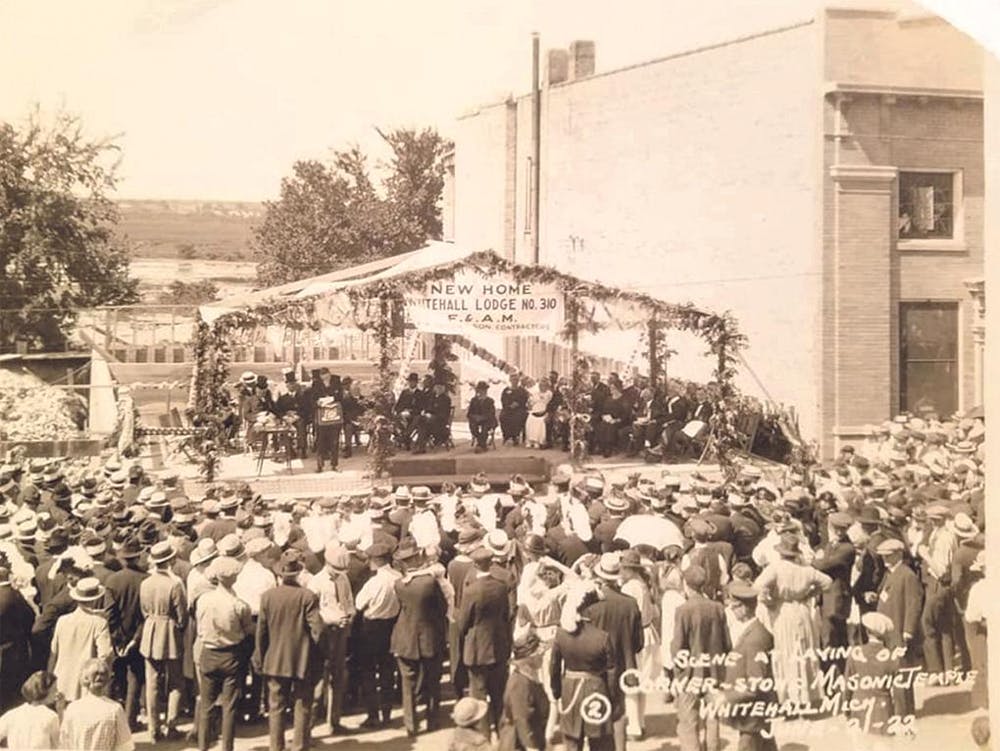
With much fanfare, the cornerstone for the Whitehall Masonic Lodge F. & A. M., No. 310 was laid July 21, 1922. Shops were closed for the afternoon, and everyone was encouraged to attend. After the completion of the building, the dedication of the Temple was held April 18, 1924. There was also a brief history of the Masonry in the area as written in 1924.
The cornerstone of the Whitehall Masonic temple building was laid by the grand lodge officers of the state with fitting and impressive ceremonies.The half-day holiday was observed by the village and many visitors from out of town were in attendance. The business places were all decorated and the town decked out in gala attire for the occasion.
A parade consisting of Knight Templars and Blue Lodge on foot and the Grand Lodge officers in autos headed by the Newsboys’ bank of Grand Rapids, formed about 2 p.m. and marched on Mears Avenue, Colby and Division streets. There were about 150 in line, which presented a very fine appearance.
The cornerstone ceremonies then took place at the stand erected on the building site for the occasion with the following grand officers present: Deputy Grand Warden Ben J. Henderson; Grand Secretary Lou B. Windsor; Grand Lecturer Frank A. Gilbert; Grand Treasurer Hugh McPherson; Grand Chaplain Wm. H. Gallagher; Junior Grand Warden Arthur J. Fox; Grand Deacon Geo. Graves; Grand Marshal B. Newton; and Grand Tyler, J. F. McGregor.
Addresses were given by the following local speakers: C. G. Pitkin, representing the village and lodge; W. E. Nelson, the Masonic Building association; L. B. Gee, the architect, and J. O. Reed gave a very comprehensive history of the organization and history of Whitehall Lodge No. 310 F. & A.M. A very interesting speech was also given by Mrs. M. B. Covell on behalf of the Covell brothers, who donated the building site for the temple and contributed generously in funds for the erection of the building.
A game of ball between Whitehall and Hesperia and the presenting of a Chevrolet car concluded the day’s program which, overall, was well carried out. The ball game resulted in a victory for Whitehall, 10-1. Ed Skeels held the lucky number, 896, that won the Chevrolet sedan.
As was reported in the local newspaper, the two-story building covered a space of 37 feet of frontage on Colby Street by 85 feet in depth, large enough to meet all demands for future growth, with every foot used to advantage and not a foot wasted in idle use.
The exterior was of tapestry brick of good color, trimmed with Bedford stone. French windows adorned its English appearing front, giving it a personal and distinguished appearance.
Entering the vestibule from the main entrance, it could be seen that it was arranged as to lead directly into the banquet hall on the first floor, also directly into the large basement which will be used for club rooms. It likewise accommodates a wide-open stairway to the left, leading to the hallways, parlors and lodge hall on the second floor. At the right of the vestibule are two rooms, one an office for committee and business meetings, the other for check room use.
The basement covered the entire ground space of the building and made the largest room in the building, regardless of the boiler and fuel rooms at its rear. It had an 11-foot ceiling and will be large enough for an excellent arrangement of equipment for club and gymnastic activities.
The banquet hall, 35 feet by 56 feet, had a seating capacity of 250 and a beautifully polished maple floor for dancing. It was decorated in warm shades of buff with a Caen stone ceiling and illuminated by the latest type of large room fixtures.
The kitchen at the rear of the banquet hall was well adapted and equipped to take care of banquets and dinners for large numbers. It had the appearance of a hotel kitchen, well-lit and ventilated.
The main stairway led into a large ante room or hall extending the width of the building, and this went to a narrow cloak hall extending nearly the length of the building. From the ante room, entrances were made to the lodge hall, parlors and preparation rooms.
Two parlors were located at the front on this floor. They were beautifully decorated in harmonizing colors and were furnished with reed furniture, Wilton velvet rugs and original paintings by Miss Winnifred Linderman, one the Harbor of Venice, painted there while on a tour. The parlors were completely furnished by Charles P. Seager’s “Believe Me” productions.
The lodge room occupied the large and remaining space on this floor. Entering the room, one’s eye was quickly attracted by its most artistic appeal and look of grandeur. Yet by closer observance, simplicity and gravity of design was found to be the keynote of beauty. One’s attention was drawn immediately to the stage resting under a larch arch, supported by two immense pillars and flanked on either side by two smaller arches, all three adorned by heavy deep-blue velvet hangings of Masonic design. At the opposite end of the room, two winding stairways led to a spacious balcony, extending the width and length of the room. It had seating capacity for 100 people and an excellent view of the stage.
The decorating scheme of this beautiful room was so arranged as to represent natural stone masonry, with a touch of Roman frieze on the pilasters. Its furnishings were in keeping with the impressive and stern appearance of its surroundings. The furniture of massive frames in a deep walnut finish was upholstered by Eagle-Ottawa leather, a gift of Wm. Hatton, General Manager of the company, in a tan finish, perfectly synchronizing and blending into the color scheme used in the decoration of the lodge room. From the high, paneled and beamed ceiling hung electrical fixtures of a unique bronze design and on the floor lay a heavy Wilton velvet carpet to complete the finishing touch to the room unsurpassed in any appointment by the lodge.
The woodwork used throughout the building was entirely red gum, with walnut doors, trimmed with antique bronze hardware. It contained an excellent ventilating system and was heated throughout by a steam radiation plant. The plumbing facilities have not been neglected, and rear entrances and a fire escape have been provided.
The Whitehall Masonic Temple is the pride of all Masons as well as the pride of the community in which their fraternal orders are functioning.
The dedication of the Masonic Temple took place April 18, 1924.
History of Montague and Whitehall Masonry
The first Masonic meeting in this community was held in the village of Montague June 26, 1866. Between the months of June and December, nine men took the Entered Apprentice degree and Fellowcraft degree, while three, namely Charles E. Covell, Lyman T. Covell and Henry P. Dowling, took the Master Mason degree. These three men were the first to receive this degree in the vicinity.
During this period the Lodge was operating under special dispensation of the Grand Lodge. Lyman T. Covell and henry P. Dowling joined the Grand Lodge while Charles E. Covell was an emeritus member.
In January 1867, a charter was granted to Montague Lodge No. 198, with 11 charter members. George E. Dowling was the first Worthy Master, Hiram E. Staples, Senior Warden and Even Knudsen, Junior Warden. From January 1867 to January 1873 the lodge increased its membership to over 40. During fall 1872, the Whitehall brothers asked for and received a charter to organize a lodge in Whitehall.
Whitehall Lodge No. 310 was granted a charter Jan. 14, 1873, with Hiram E. Staples its first Worthy Master, which position he held for seven years – a greater period in that office than had ever been held by any one person since its organization. K. F. Morse was Senior Warden and Chas. E. Covell, Junior Warden.
The first lodge rooms were in a building west of the railroad tunnel over Colby Street. This building was occupied for several years until a portion of the town was destroyed by fire in 1881. The fraternity then procured quarters in the Lyman T. Covell block, directly west of its new temple which was dedicated April 18, 1924. These lodge rooms were occupied until a second fire completely destroyed the building in 1890.
The first fire started during the night of Saturday, July 30, 1881, and consumed in its path the major portion of Whitehall’s business district at the west end of Colby Street. The second – known as the big town fire – started early in the morning Friday, Sept. 19, 1890, and continued for several days, wiping out nearly all of the business district and a large share of the residential district on the north side of town.
By this time nearly all the business and professional people of this community were members of the Masonic organization, and they went to work with true Masonic energy and the ability to rebuild their own little town.
After the second fire, in which the majority of the records of the order were lost, they moved to the block now known as the “Pitkin Block” and where they held meetings for over 30 years, until they removed to their own beautifully appointed temple in 1924.
In early October 1879, wives, mothers, sisters and daughters of the Master Masons were granted a charter to organize the Order the Eastern Star on White Lake. Marie Elsie Staples was the first Worthy Matron, Joseph Hazeltine was the first Worthy Patron and Mable Busby, assistant Worthy Matron. From the time this chapter was organized until 1924, the lodge increased in membership and popularity more rapidly than ever before.
The Montague Lodge was started by George Dowling and first met in the Ferry-Dowling building on the corner of Ferry and Dowling in June 1866. In 1881 the Montague Masons moved to the second floor of the Ripley Block and later the second floor of Sweet’s store. In 1921 the Masonic Building Association, made up of lodge members, bought the White Lake Inn, once known as the Sadler Block on the corner of Water and Dowling.
They remained at this location until 1970, when sites for a new lodge were selected on the corner of Dowling and Whitbeck. The old building was sold in 1975 and was torn down in 1978. In 1975 Montague moved to their new Temple. In 1979 the Whitehall members began using these facilities as their Temple. In 1998 the Lodges merged into the Montague-Whitehall Lodge No.198 F & AM, which is located at 5425 Dowling Street in Montague.
To realize how fully Masonry has changed in the area from one time to another, it is necessary to look over the old application blanks and under the caption, “What is your occupation?”, we find such terms as these: Camp foreman, river driver, sailor, timber cruiser, stage coach driver, etc., occupations of the days when this community was at the height of the lumbering era. Under the application of today we would not be surprised to find such occupations listed as these: wireless operator, chemical or electrical engineer, radio expert, etc.
Over the years since the building in Whitehall was vacated by the Masonic members, several businesses have been located there. The building is now home to “The Loft on Colby” and “The Colby Escape Room”.
In 2021, after extensive updating, “The Loft on Colby” opened on the second floor of the Masonic Temple building. The one of a kind property has two bedrooms, two and one half baths and an open sleeping loft (in the former balcony). It can easily accommodate eight guests.
In 2023 “The Colby Escape Room” opened for business. Designed to give you the most thrilling and authentic experience, you race against the clock to “escape” the room by solving engaging puzzles and challenges that promote creative thinking, teamwork and communication.